Australia is close to the size of the lower 48 states of America, and that one fact catches out more first-time visitors than anything else. People land in Sydney with ten days and a wish list that includes Uluru, the Reef, Tasmania and Perth, then spend half the holiday sitting in airports. This guide is written to stop that from happening.
Below you will find fifteen places that deserve a spot on a first or second trip, grouped by region so you can see what sits close together and what really does not. Every entry has a street or park address, the best months to go, a realistic amount of time to allow, and an editorial rating out of five. The ratings are our own opinion, built from four simple scores, and they are not a poll of thousands of reviewers. Use them as a starting point, then argue with them.
If you only have a week, pick one region and do it properly. If you have three weeks, you can link two or three. Either way, you will leave with a list of things you did not get to, and that is not a failure. That is just what Australia does to people.
All 15 places at a glance
This table is the short version. The detail, and the reasoning behind each rating, follows further down.
| # | Place | State | Best months | Time to allow | Rating |
| 1 | Sydney Harbour and Opera House | NSW | Sep to Nov, Mar to May | 3 to 4 days | 4.5 / 5 |
| 2 | Blue Mountains | NSW | Mar to May, Sep to Nov | 1 to 2 days | 4.4 / 5 |
| 3 | Byron Bay | NSW | Sep to Nov | 2 to 3 days | 4.0 / 5 |
| 4 | Great Barrier Reef (Cairns) | QLD | Jun to Oct | 2 to 3 days | 4.4 / 5 |
| 5 | Whitsunday Islands | QLD | Apr to Nov | 3 to 4 days | 4.1 / 5 |
| 6 | Daintree Rainforest | QLD | May to Oct | 2 days | 4.3 / 5 |
| 7 | K’gari (Fraser Island) | QLD | Apr to Oct | 2 to 3 days | 3.9 / 5 |
| 8 | Uluru and Kata Tjuta | NT | May to Sep | 3 nights | 4.3 / 5 |
| 9 | Kakadu National Park | NT | May to Oct | 3 days | 4.1 / 5 |
| 10 | Melbourne | VIC | Mar to May, Sep to Nov | 3 to 4 days | 4.4 / 5 |
| 11 | Great Ocean Road | VIC | Oct to Apr | 2 days | 4.4 / 5 |
| 12 | Tasmania | TAS | Dec to Mar | 5 to 7 days | 4.3 / 5 |
| 13 | Perth and Rottnest Island | WA | Oct to Apr | 4 days | 4.0 / 5 |
| 14 | Ningaloo Reef | WA | Mar to Oct | 4 to 5 days | 4.0 / 5 |
| 15 | Kangaroo Island | SA | Oct to Apr | 2 to 3 days | 4.0 / 5 |
How the ratings work
Each place gets a score out of five for four things: scenery, how unique the experience is, how easy it is to reach, and value for the money you will probably spend. The rating is the average. Remote spots like Ningaloo lose points on access even though the experience itself is superb, which is why the chart below puts a city like Sydney ahead of far wilder places. Neither is wrong. They just answer different questions.
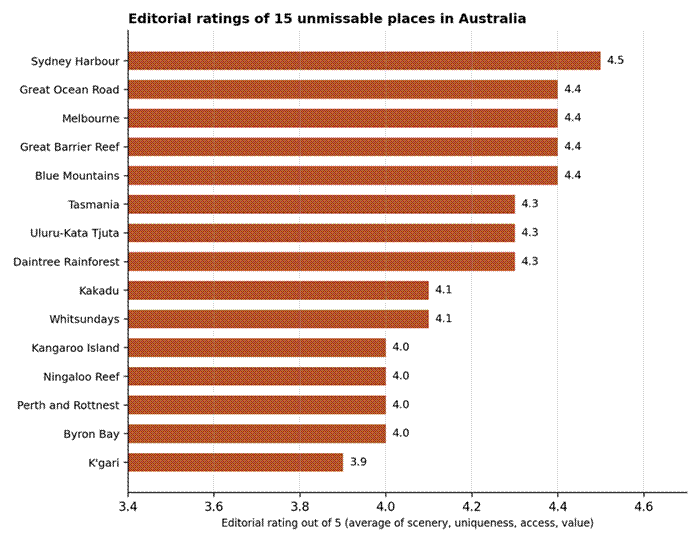
Editorial ratings for each place. Source: our own scoring, based on scenery, uniqueness, access and value.
Before you plan anything: the distance problem
Flying is how most visitors link the big stops, and the flight times below are rough, direct-flight figures to help you judge what is realistic. Schedules change, so always check with the airline.
| Route | Approximate flight time | Good for |
| Sydney to Melbourne | 1 hour 30 minutes | Pairing the two big cities |
| Sydney to Cairns | 3 hours | Reef and Daintree |
| Sydney to Uluru (Ayers Rock Airport) | 3 hours 30 minutes | Red Centre |
| Melbourne to Hobart | 1 hour 20 minutes | Tasmania |
| Sydney to Perth | 5 hours | Western Australia |
| Perth to Learmonth (Exmouth) | 2 hours | Ningaloo Reef |
| Adelaide to Kangaroo Island | 30 minutes | Island day trip or stay |
Notice how few of those pairs are close. Australia rewards people who pick fewer places and stay longer. If you try to see everything on this list in one go, you will see mostly the inside of a plane.
New South Wales: harbour, bush and a very famous beach town
1. Sydney Harbour and the Opera House
Address: Sydney Opera House, Bennelong Point, Sydney NSW 2000
Best time: September to November and March to May for mild weather; December to February for beach days
Time to allow: 3 to 4 days
Editorial rating: 4.5 out of 5
Yes, it is obvious. It is also obvious for good reason. The white shells of the Opera House still look like nothing else on earth, especially from the water, and the best way to see them is from a Circular Quay ferry rather than from the forecourt. A standard ferry ride to Manly costs the same as any other public transport trip and gives you the harbour, the bridge and the skyline for no extra charge.
Once you have done the postcard views, walk the Bondi to Coogee coastal path. It is about six kilometres of cliffs, rock pools and sandy detours. Finish with a swim at Bondi Icebergs (1 Notts Avenue, Bondi Beach NSW 2026), where the pool fills with real ocean water. Sydney is not cheap, but the best parts of it cost nothing at all. When the walking is done, our round-up of the best Italian restaurants in Sydney lists tables worth booking ahead.
2. Blue Mountains
Address: Echo Point, Katoomba NSW 2780 (Three Sisters lookout)
Best time: March to May and September to November
Time to allow: 1 to 2 days
Editorial rating: 4.4 out of 5
You can reach Katoomba by train from Sydney Central in around two hours, which makes this the easiest big landscape on the whole list. The famous view is the Three Sisters from Echo Point, but the crowds thin out quickly once you walk a few hundred metres along the cliff edge. Scenic World (corner of Violet Street and Cliff Drive, Katoomba NSW 2780) runs a steep railway and a cableway through the canopy, and it is a good wet-weather option.
The haze that gives the range its name comes from fine oil droplets released by eucalyptus trees, which scatter blue light. It is not a marketing story. On a warm, still morning you can actually see it. The region is part of a World Heritage listed area, so stick to the marked tracks and carry water even on short walks. Winter is cold enough for open fires in the guesthouses, which is its own kind of appeal.
3. Byron Bay
Address: Cape Byron Lighthouse, Lighthouse Road, Byron Bay NSW 2481
Best time: September to November; whale season runs roughly June to November
Time to allow: 2 to 3 days
Editorial rating: 4.0 out of 5
Byron has a reputation for yoga studios and juice bars, and both are real, but the reason to go is the headland. Cape Byron is the most easterly point on the Australian mainland, and the walk up to the lighthouse is short enough for kids and rewarding enough that you will still do it twice. Dolphins are common in the water below. From roughly June to November, humpback whales pass close to shore on their migration.
Be honest with yourself about timing. School holidays turn the town into a queue, and accommodation prices climb sharply. Visit midweek in spring and Wategos Beach, just below the lighthouse, feels like a private cove. Gold Coast Airport at Coolangatta is the nearest major gateway, roughly 45 minutes away by road.
Queensland: reef, rainforest and the world’s biggest sand island
4. Great Barrier Reef
Address: Reef Fleet Terminal, 1 Spence Street, Cairns City QLD 4870 (departure point for most reef trips)
Best time: June to October, when the water is calm and stingers are rare
Time to allow: 2 to 3 days
Editorial rating: 4.4 out of 5
The Great Barrier Reef stretches for more than 2,300 kilometres and is the largest coral reef system on the planet. Nobody sees all of it, and that is the first thing to understand. You are choosing a section, and sections differ a lot. Outer reef trips from Cairns reach clearer water and healthier coral than inner reef options, though they cost more and take longer.
Pick a smaller boat if you can. Groups of thirty or fewer feel very different from a pontoon with hundreds. Stinger suits are advisable from about November to May, and reef-safe sunscreen is worth the extra few dollars. The reef has been through several bleaching events, and conditions vary from one reef to the next, so check current advice from the Great Barrier Reef Marine Park Authority before you book. It is still extraordinary. Just go with realistic expectations.
5. Whitsunday Islands
Address: Port of Airlie, Shingley Drive, Airlie Beach QLD 4802 (main departure hub)
Best time: April to November
Time to allow: 3 to 4 days
Editorial rating: 4.1 out of 5
Seventy-four islands, and most people only ever see two or three. The headline is Whitehaven Beach, a seven-kilometre strip of silica sand so fine it squeaks underfoot and stays cool even at midday. The lookout at Hill Inlet, on the northern end of Whitsunday Island, shows the tidal swirl of sand and water that ends up on every brochure. Go at low tide for the best colours.
Sailing is the classic way to do it. A skippered charter is the sensible choice if you have never handled a boat, and a two-night trip gives you time for snorkelling and a sunset anchorage without feeling rushed. Day trips from Airlie Beach work if you are short on time, but you lose the quiet hours when the day boats leave.
6. Daintree Rainforest
Address: Daintree Discovery Centre, Tulip Oak Road, Cow Bay QLD 4873
Best time: May to October, the drier months
Time to allow: 2 days
Editorial rating: 4.3 out of 5
The Daintree is often described as around 180 million years old, which would make it older than the Amazon. Whatever the exact figure, it feels ancient. The forest runs right down to the sand at Cape Tribulation, where rainforest and reef sit side by side, and it is home to the southern cassowary, a large flightless bird that you should treat with real respect.
Base yourself in Port Douglas, about an hour north of Cairns, and cross the Daintree River on the cable ferry. Take a guided river cruise to spot crocodiles safely, and do not swim in any river or creek, however inviting it looks. After a day of boardwalks, the best restaurants in Port Douglas are an easy walk from most hotels.
7. K’gari (Fraser Island)
Address: K’gari (Fraser Island), Queensland 4581
Best time: April to October; humpback whales are best seen from Hervey Bay from about August
Time to allow: 2 to 3 days
Editorial rating: 3.9 out of 5
K’gari is the largest sand island in the world, and it is also covered in rainforest, which still seems impossible. It is roughly 120 kilometres long. Lake McKenzie, with its pale sand and clear blue water, is the postcard stop, but Eli Creek and the rusting Maheno shipwreck on Seventy-Five Mile Beach are just as memorable.
The island is four-wheel-drive only, with soft sand tracks and a tide-dependent beach highway, so most visitors book a guided tour or hire a vehicle with a permit. Dingoes live here, and they are wild. Keep your distance, never feed them, and keep children close. Barges leave from River Heads near Hervey Bay and from Inskip Point near Rainbow Beach.
Northern Territory: the Red Centre and the Top End
8. Uluru and Kata Tjuta
Address: Uluru-Kata Tjuta National Park, Yulara NT 0872
Best time: May to September, when days are mild; summer is extremely hot
Time to allow: 3 nights
Editorial rating: 4.3 out of 5
Uluru rises about 348 metres from flat red desert, and photographs do not prepare you for the scale. The base walk is roughly ten kilometres and takes a few hours at an easy pace. Walk it early, before the heat arrives. Climbing the rock has been closed permanently out of respect for the Anangu traditional owners, who have long asked visitors not to. The park’s official site, Parks Australia, explains the cultural background and current access.
Do not skip Kata Tjuta, a cluster of domed rock formations about 40 kilometres west. The Valley of the Winds walk is the standout, though it closes in extreme heat. Most visitors fly into Ayers Rock Airport and stay at Yulara, the resort village near the park. Driving from Alice Springs is possible, but it is a long day on a very empty road.
9. Kakadu National Park
Address: Bowali Visitor Centre, Kakadu Highway, Jabiru NT 0886
Best time: May to October (dry season)
Time to allow: 3 days
Editorial rating: 4.1 out of 5
Kakadu covers almost 20,000 square kilometres, roughly the size of Slovenia, and it is World Heritage listed for both its natural and cultural value. The rock art at Ubirr and Burrungkuy (Nourlangie) is among the oldest continuing art traditions anywhere, and the sunset view from the top of Ubirr across the floodplain is one of the best in the country.
Go in the dry season. During the wet months, from about November to April, floodwaters close roads and some of the main sites. Book a Yellow Water Billabong cruise at Cooinda for birds, buffalo and saltwater crocodiles at close range. Allow a few days, and drive in from Darwin, roughly three hours to Jabiru.
Victoria and Tasmania: coffee, coastline and cold-climate wild country
10. Melbourne
Address: Hosier Lane, Melbourne VIC 3000; Queen Victoria Market, 513 Elizabeth Street, Melbourne VIC 3000; National Gallery of Victoria, 180 St Kilda Road, Melbourne VIC 3006
Best time: March to May and September to November
Time to allow: 3 to 4 days
Editorial rating: 4.4 out of 5
Melbourne is a city you explore by getting a little lost. The laneways, Hosier Lane with its constantly changing street art among them, hide cafes, bars and tiny galleries that you would walk straight past on the main streets. The free tram zone in the centre makes it easy to zigzag between districts without thinking about fares.
Coffee is a serious topic here, and locals have strong opinions about it. Our list of the best coffee roasters in Melbourne is a good place to start. Add the National Gallery of Victoria for rainy afternoons, Queen Victoria Market for lunch, and a football match at the MCG if the season suits. Yes, the weather really can change several times in a day. Pack a light jacket whatever the forecast says.
11. Great Ocean Road
Address: Twelve Apostles, Great Ocean Road, Princetown VIC 3269
Best time: October to April for weather; June to September for whale watching at Warrnambool
Time to allow: 2 days
Editorial rating: 4.4 out of 5
The Great Ocean Road is 243 kilometres of coastal driving between Torquay and Allansford, and it was built by returned soldiers after the First World War. It doubles as a memorial, and the arch at Eastern View is worth a quick stop for that reason alone.
The limestone stacks of the Twelve Apostles are the main event, and only a handful still stand. Go at sunrise or late afternoon, when the crowds are thinner and the light turns the cliffs gold. Loch Ard Gorge nearby is quieter and arguably prettier. Koalas sit in the gum trees around Kennett River, so keep an eye on the branches above your head. Do not try to cram the whole road into a day trip. Staying a night at Apollo Bay or Port Campbell changes the whole experience.
12. Tasmania
Address: Museum of Old and New Art (MONA), 655 Main Road, Berriedale TAS 7011; Freycinet National Park, Coles Bay TAS 7215; Cradle Mountain Visitor Centre, 4057 Cradle Mountain Road, Cradle Mountain TAS 7306
Best time: December to March
Time to allow: 5 to 7 days
Editorial rating: 4.3 out of 5
Tasmania is small by Australian standards and enormous in character. Roughly 40 per cent of the island is protected as national park or reserve, which explains why so much of it still looks wild. Start in Hobart, where the Saturday market at Salamanca Place and the eccentric, underground MONA give you two very different faces of the city.
Then head north-east to Freycinet and the walk up to the Wineglass Bay lookout, which takes around an hour and a half return and delivers one of the best beach views in the country. Cradle Mountain is the highland counterpart, with alpine lakes and the start of the 65-kilometre Overland Track. Weather turns fast here, even in summer, so pack warm layers and a waterproof. Hire a car, and give yourself more time than you think you need.
Western and South Australia: remote beaches and wildlife
13. Perth and Rottnest Island
Address: Kings Park, Fraser Avenue, West Perth WA 6005; Thomson Bay Settlement, Rottnest Island WA 6161
Best time: October to April; wildflowers from about August to October
Time to allow: 4 days
Editorial rating: 4.0 out of 5
Perth faces the Indian Ocean, which means the sun sets over the water, and that single detail changes how an evening at Cottesloe Beach feels. Kings Park is one of the largest inner-city parks in the world, with views across the river to the skyline, and it fills with wildflowers in spring. Fremantle, about 20 minutes away by train, has a historic port, markets, and the old Fremantle Prison at 1 The Terrace, Fremantle WA 6160.
From Fremantle, a ferry of about 25 to 30 minutes takes you to Rottnest Island, home to the quokka. Hire a bike, because the island is largely car-free, and ride out to a quiet bay. Please do not touch or feed the quokkas, however friendly they seem. Perth is a long way from everywhere else, so treat it as its own trip rather than a quick add-on.
14. Ningaloo Reef
Address: Milyering Visitor Centre, Cape Range National Park, near Exmouth WA 6707
Best time: March to October; whale sharks roughly March to July, humpback whales from July
Time to allow: 4 to 5 days
Editorial rating: 4.0 out of 5
Ningaloo is a fringing reef, which means it starts just metres from the beach. You can wade in from the sand at Turquoise Bay and be snorkelling over coral within a minute or two. The reef runs for roughly 300 kilometres along the Coral Coast and is World Heritage listed. Between about March and July, it is also one of the few places where you can swim with whale sharks, in tightly regulated tours.
Getting there takes effort. Fly Perth to Learmonth, a trip of around two hours, or commit to a long drive of more than a thousand kilometres. The reward is a reef with far fewer crowds than the east coast. Book accommodation early, because the town of Exmouth is small and fills quickly in peak season.
15. Kangaroo Island
Address: Flinders Chase National Park, Kangaroo Island SA 5223 (Remarkable Rocks and Admirals Arch)
Best time: October to April
Time to allow: 2 to 3 days
Editorial rating: 4.0 out of 5
Kangaroo Island packs a lot of wildlife into one place. Australian sea lions rest on the beach at Seal Bay, where guided tours let you walk close without disturbing them. Koalas sit in the eucalypts, and you will see kangaroos and wallabies at dusk. In Flinders Chase National Park, the Remarkable Rocks, huge granite boulders sculpted by wind and sea, are best seen near sunset, and Admirals Arch below is a short drive away.
A ferry from Cape Jervis, roughly 110 kilometres south of Adelaide, reaches Penneshaw in about 45 minutes. Flights from Adelaide take about half an hour. Bushfires burned a big share of the island a few summers ago, but the bush has recovered and wildlife viewing is strong again. Local honey, oysters and gin make the food trail worth following. Before you board the ferry, check out the best Thai restaurants in Adelaide for a proper meal in the city.
Putting it together: three sample routes
These are starting points, not rules. Swap pieces in and out depending on the season and your budget.
| Trip length | Suggested route | Why it works |
| 7 days | Sydney (3 days), Blue Mountains (1 day), fly to Cairns for the Reef and Daintree (3 days) | City, bush and reef with only one flight |
| 14 days | Sydney, fly to Uluru (3 nights), fly to Cairns (4 nights), then Melbourne and the Great Ocean Road (4 nights) | Covers four very different landscapes |
| 21 days | Add Tasmania (5 nights) and Perth with Rottnest (3 nights) to the 14-day route | Takes in both coasts and the island state |
Practical tips that save time and money
- Check your visa early. Most visitors need approval before travelling. The Department of Home Affairs lists options on its visa information pages.
- Pack for sun, not just heat. UV levels are high even on cool, cloudy days. The Cancer Council recommends a hat, sunglasses, sunscreen and covered shoulders, and its sun protection advice is worth a read.
- Swim between the flags. Surf life savers mark safe areas on patrolled beaches. Surf Life Saving Australia publishes beach safety guides.
- Drive on the left, and respect distances. Fatigue is a genuine risk on long outback roads. Break up drives and avoid driving at dusk, when wildlife is active.
- Check the weather before you commit. The Bureau of Meteorology gives regional forecasts and warnings for heat, cyclones and flooding.
- Buy travel insurance. Remote regions can mean expensive evacuations, and cancelled flights are common during the wet season in the north.
Final thoughts
The honest truth is that nobody ever finishes Australia. The country is too big, too varied and too far from everything else for that. What you can do is choose places that match the way you like to travel, give them enough time, and leave room for surprises. Start with the section of this list that makes you most curious, and build outwards from there.
If you are looking at the other side of the Tasman, our Rotorua travel guide is a good next read for a New Zealand add-on.
Frequently asked questions
What is the single most unmissable place in Australia?
It depends on what you want, but if we had to choose one, we would say Sydney Harbour for first-timers and Uluru for repeat visitors. Sydney gives you famous landmarks, beaches and good food within easy reach. Uluru gives you something you cannot see anywhere else. For a broader overview of the country, the Wikipedia entry on Australia is a handy reference.
How many days do I need to see the main sights?
Ten days lets you do one region well, for example Sydney plus the Reef. Two weeks allows you to add Uluru or Melbourne. Three weeks or more is better if you want Tasmania or Western Australia. Rushing is the most common mistake, so choose fewer places and enjoy them.
What is the best time of year to visit Australia?
There is no single best time, because the country spans tropical, desert and temperate zones. As a general rule, spring (September to November) and autumn (March to May) suit most of the south, while the dry season (May to October) suits the tropical north and Red Centre. Check regional forecasts on the Bureau of Meteorology website before booking.
Do I need a visa to visit Australia?
Most overseas visitors do, including many who only intend to stay for a few days. Requirements depend on your passport. The Department of Home Affairs publishes the official list on its visa and immigration site, and you should always apply through that official source.
Can I still climb Uluru?
No. The climb has been permanently closed, in line with the wishes of the Anangu traditional owners. You can walk around the base, join a ranger-guided tour, and visit the cultural centre instead. See Parks Australia for current access and safety information, or read the background in the Uluru Wikipedia article.
Is the Great Barrier Reef still worth visiting?
Yes, though it is worth being realistic. Parts of the reef have been affected by coral bleaching, and conditions vary by location. Outer reef sites generally offer the best snorkelling and diving. The Great Barrier Reef Marine Park Authority publishes up-to-date information, and the Wikipedia page on the reef gives a good scientific overview.
Are dangerous animals a real worry for visitors?
Less than the internet suggests, but sensible caution matters. Do not swim in rivers or creeks in the tropical north, where saltwater crocodiles live, and wear a stinger suit in the water from about November to May. Swim at patrolled beaches, and never approach wildlife. The Australian government’s Smartraveller site has current travel advice.
Should I hire a car or fly between places?
Fly between regions and hire a car within them. Hiring a car makes sense for the Great Ocean Road, Tasmania and the Daintree, where public transport is limited. For long distances, such as Sydney to Perth, flying saves days. Always check your travel insurance covers driving, especially on unsealed roads.
Which places suit families with young children?
The Blue Mountains, Kangaroo Island, the Gold Coast hinterland and Rottnest Island are all child-friendly, with short walks and plenty of animals. Melbourne and Sydney also work well because of their free or cheap parks and playgrounds. For food stops, the guides to the best pizza in Brisbane and best coffee roasters in Melbourne help you plan.
What is the cheapest way to experience Australia?
Travel in the shoulder seasons, book accommodation early, and focus on free experiences such as coastal walks, beaches and national parks. Cities like Sydney and Melbourne have plenty of low-cost things to do, but remote places such as Ningaloo and Uluru cost more because of flights and limited accommodation.
Related posts
- Best Italian Restaurants in Sydney: 20 Tables Worth Booking
- Best Coffee Roasters in Melbourne: 12 Local Favourites Worth the Queue
- Best Restaurants in Port Douglas: Where to Eat from Wharf Street to Macrossan Street
- Best Thai Restaurants in Adelaide: 20 Local Picks, Prices and Honest Notes
- Best Pizza in Brisbane: 20 Local Favourites Worth Your Appetite
- Rotorua Travel Guide: Steam, Culture and Adrenaline in the North Island
Disclaimer
The information in this article is provided for general guidance only. Opening hours, prices, access rules, weather conditions, park closures and safety advice can change without notice, and some places listed here may close seasonally or because of weather, flooding, fire or cultural reasons. Always confirm details with the relevant operator, park authority or official government source before you travel. Ratings are the editorial opinion of the author and are not based on guest reviews.
This article is not a substitute for professional travel, medical, legal or insurance advice, and the author accepts no responsibility for loss, injury or inconvenience arising from reliance on it. External links lead to third-party websites, which we do not control and are not responsible for.