You smell Rotorua before you see it. Somewhere on the drive in, the air turns faintly eggy, and locals will tell you the nose adjusts within a day. Then you notice the steam curling out of a roadside drain, a suburban garden with its own little vent, a park where mud is quietly bubbling behind a fence. This is a town that sits on top of a very active piece of the planet, and it has built a whole way of life around that fact.
Rotorua is a city in the Bay of Plenty on the southern shore of the lake it is named after, home to roughly 58,500 people according to Wikipedia’s Rotorua entry. The best-known draw is the Whakarewarewa valley, where the Pōhutu Geyser can shoot up to around 30 metres and erupts many times a day. Right beside it sits a living Māori village and the national institute that teaches carving and weaving. Add hot pools, redwoods, white water and a luge, and you can see why so many first-time visitors to the North Island end up here.
This guide is built for planning. It covers what is actually worth your time, roughly where things are, what people rate highly, and how to string it all together in two or three days without spending half of it in the car.
Rotorua at a glance
| Question | Quick answer |
| Where is it? | Central North Island, on the southern edge of Lake Rotorua |
| Known for | Geysers, boiling mud, hot pools, Māori culture, forest and lake adventures |
| Time needed | Two nights covers the highlights; three is more relaxed |
| Smell factor | Sulphur is part of the deal, strongest near the lakefront and geothermal parks |
| Good in the rain? | Yes. Hot pools, cultural shows and geothermal walks all work in wet weather |
Getting to Rotorua
Most people arrive by road. From Auckland it is about 230 kilometres, which usually means a three hour drive, and the route is straightforward. If you are coming from the Bay of Plenty side, Tauranga is only about an hour away. Buses run from the major centres, and Rotorua has a small airport with domestic flights, though for many trips driving works out simpler and cheaper.
| From | Distance | Rough drive time |
| Auckland | About 230 km | Around 3 hours |
| Hamilton | About 105 km | Around 1 hour 15 minutes |
| Tauranga | About 60 km | Around 1 hour |
| Taupō | About 80 km | Around 1 hour |
If you are building a longer North Island loop, Rotorua slots in neatly before heading east. Our guide to the best things to do in Gisborne picks up from there, and it is a good pairing if you want a quieter stretch of coast after the geothermal buzz.
Geothermal parks: which one should you pick?
Rotorua has several geothermal attractions and they are not interchangeable. Each has a different mood, so it helps to decide what you care about before you buy a ticket.
1. Te Puia
Te Puia is the one with the big geyser. It sits in the Whakarewarewa valley, and the guided walk takes you past Pōhutu, boiling pools and a kiwi house. It also doubles as a cultural centre, so you can watch carvers and weavers at work and add a performance to your visit. Address: 20 Hemo Road, Whakarewarewa. Google rating at the time of writing: 4.5 from more than 9,000 reviews. See tepuia.com for current session times.
2. Waimangu Volcanic Valley
If you like walking and dislike crowds, this is the strongest pick. The trail runs mostly downhill through a landscape that was reshaped by a huge eruption, past steaming lakes and terraces, and ends at a lake where you can hop on a short boat cruise. Shuttles bring you back up. It has the joint-highest rating of the big geothermal parks, 4.7 from around 2,800 reviews. Address: 587 Waimangu Road. Details at waimangu.co.nz.
3. Wai-O-Tapu Thermal Wonderland
Wai-O-Tapu is the colourful one. The Champagne Pool, with its orange rim and green water, is the photo everyone wants, and the daily Lady Knox Geyser display at 10.15am draws a crowd. Arrive early or after lunch to dodge the mid-morning rush. Address: 201 Waiotapu Loop Road. Rated 4.6 from more than 8,600 reviews. Bring water, because the walk is longer than it looks. Info at waiotapu.co.nz.
4. Hell’s Gate
Hell’s Gate is bleak and a bit wild, with steaming ground, mud volcanoes and the option of a mud bath afterwards. It is less pretty than the others, but the guided tour is well reviewed and the mud spa is a genuinely different experience. Address: 351 State Highway 30, Tikitere. Rating: 4.5 from over 4,200 reviews.
5. Kuirau Park (free)
On a tight budget, or with an hour to spare? Kuirau Park is right in town, open around the clock, and free. You will find steaming ponds, bubbling mud and a couple of thermal foot baths, plus a playground and a Saturday market. Address: Pukuatua Street. Rated 4.5 from more than 3,600 reviews.
How the top attractions compare
Here is a quick reference for the places mentioned in this guide. Ratings are Google ratings at the time of writing and will move over time, so treat them as a guide rather than a promise.
| Attraction | Address | Best for | Google rating |
| Te Puia | 20 Hemo Road, Whakarewarewa | Geyser plus culture | 4.5 |
| Whakarewarewa Village | 17 Tryon Street, Whakarewarewa | Living village tour | 4.5 |
| Waimangu Volcanic Valley | 587 Waimangu Road | Quiet scenic walk | 4.7 |
| Wai-O-Tapu | 201 Waiotapu Loop Road | Colour and photos | 4.6 |
| Hell’s Gate | 351 State Highway 30, Tikitere | Mud bath and tour | 4.5 |
| Kuirau Park | Pukuatua Street, central | Free geothermal stop | 4.5 |
| Polynesian Spa | 1000 Hinemoa Street, lakefront | Lake view soak | 4.5 |
| Wai Ariki Hot Springs | 1047 Whakaue Street | Premium spa day | 4.7 |
| Redwoods Treewalk | 1 Tītokorangi Drive | Forest and lantern walk | 4.6 |
| Skyline Rotorua | 178 Fairy Springs Road | Gondola and luge | 4.5 |
| Kaituna Cascades | 18 Okere Falls Road, Okere Falls | White water rafting | 5.0 |
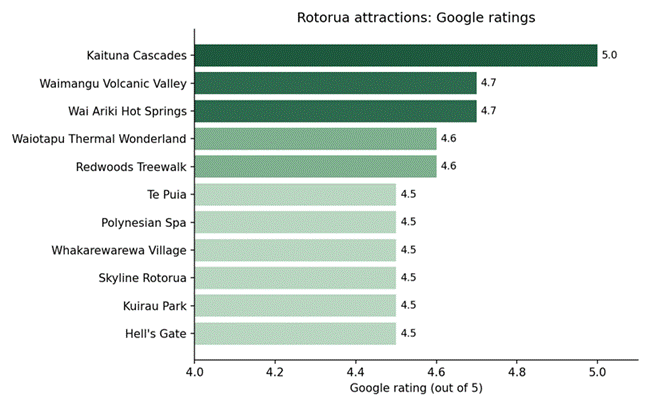
Google ratings for popular Rotorua attractions, checked at the time of writing.
Māori culture in Rotorua
Rotorua is where a lot of visitors get their first proper introduction to Māori culture, and it is worth going in with some context. The local iwi is Te Arawa, whose ancestors settled here centuries ago, and the geothermal energy underfoot shaped daily life for cooking, bathing and heating long before tourism arrived.
For a genuine sense of daily life, Whakarewarewa, the Living Māori Village is hard to beat. Residents still use natural steam boxes and boiling pools for cooking, and the guides are locals who grew up in the community. It rates 4.5 from over 3,500 reviews. Address: 17 Tryon Street.
If you would like an evening out, several venues run a welcome ceremony, a haka and song performance and a hāngī meal, which is food steamed in an earth oven. Te Puia offers a version alongside its geyser walk, and other operators around town do their own. Book ahead in peak months, and ask what is included before you pay, because packages vary a lot.
For something free and low-key, walk around Ōhinemutu on the lakefront. The carved meeting house and the church beside it are lovely, and you can see steam venting between the houses. It is a lived-in neighbourhood, so keep your voice down, stay on public paths and skip the drone.
Hot pools and spas
After a day of walking around sulphur, a soak is the obvious reward. Rotorua has options at every price.
- Polynesian Spa: right on the lake at 1000 Hinemoa Street. The lakefront views are the point, and the private lake pools suit couples. Rated 4.5 from nearly 9,000 reviews. Sunset and early morning are the nicest times. See polynesianspa.co.nz.
- Wai Ariki Hot Springs and Spa: a newer, more polished option in the centre of town at 1047 Whakaue Street. Its sauna, pool and mud sequence is popular, and reviewers give it 4.7. Timeslots are limited, so book online.
- Waikite Valley: open-air pools south of town, fed by a very large natural spring. Good value and usually quieter. Check hotpools.co.nz before you go.
A safety note: stick to managed, tested pools. In wild hot streams and springs, keep your head out of the water, and never step off the marked path in a geothermal park. The ground crust can be thin and the water can be scalding.
Adventure and outdoors
Rotorua is the North Island’s answer to Queenstown when it comes to getting your heart rate up. If you are weighing the two, our guide to the best cafes in Queenstown shows what the southern adventure hub looks like once you come down from the mountains.
- White water rafting on the Kaituna River: the drop over Tutea Falls, at about seven metres, is the headline. Kaituna Cascades near Okere Falls holds a 5.0 rating from more than 2,800 reviews.
- Skyline Rotorua: a gondola up the hill behind town, then a luge run back down. Buying a multi-ride pass is the tip repeat visitors give, because two goes never feels like enough. Address: 178 Fairy Springs Road.
- Redwoods Treewalk: suspension bridges through the forest canopy, with lantern lighting after dark. The queue for the evening session can be long in busy periods, and some reviewers say the daytime walk shows off the trees better. Address: 1 Tītokorangi Drive. Rated 4.6.
- Blue Lake (Lake Tikitapu): a calm swimming and walking spot, with a track around the shore that takes about an hour and a half. Google reviewers rate it 4.7.
If you like proper hiking rather than a stroll, the region has plenty. For a sense of how a big alpine day compares, read our breakdown of the Mueller Hut route in the South Island.
A simple two-day plan
Day one: steam and story
- Morning: Waimangu Volcanic Valley, allowing at least half a day if you take the boat cruise.
- Afternoon: soak at Waikite Valley on the way back, or head straight to the Polynesian Spa.
- Evening: a hāngī dinner and performance, then a slow walk along the lakefront.
Day two: culture and thrills
- Morning: Whakarewarewa Village or Te Puia, whichever suits your budget.
- Afternoon: Skyline luge or a Kaituna rafting trip.
- Evening: Redwoods lantern walk, or a late session at Wai Ariki.
Daylight shapes how much you can squeeze in, especially outside summer. Our note on sunrise and sunset times across New Zealand is handy for timing photos and outdoor stops.
Where to stay and eat
Motels line Fenton Street and tend to offer the best value, though it is a busy road. Central hotels put you within walking distance of dinner and the lakefront. If you want peace, look at lodges and holiday parks around the lakes, but you will need a car. Whichever you choose, ask about a private thermal pool. Plenty of motels have one, and a late soak after a long day is a very Rotorua way to finish.
For food, the central restaurant strip on Tutanekai Street, known as Eat Streat, has a good spread of casual options, and the hāngī experiences are the obvious choice for traditional cooking. Cafes around the centre are reliable for a proper flat white before you head out.
Practical tips before you go
- Wear shoes you do not mind getting muddy or smelling faintly of sulphur. Jewellery, especially silver, can tarnish around some geothermal areas.
- Lock your car and keep valuables out of sight at trailheads and roadside pools, as in most tourist areas.
- Book popular experiences ahead in school holidays and long weekends.
- Bring water and sun protection. Geothermal parks have little shade.
- Check operator websites for current hours and pricing, since both change.
Frequently asked questions
How many days do you need in Rotorua?
Two nights is enough for one geothermal park, a cultural evening, a hot pool and one adventure activity. Three nights lets you add a hike or a second park without rushing. Planning a bigger trip? Our Gisborne guide is a good next stop for a coastal follow-up.
Why does Rotorua smell?
The smell is hydrogen sulphide gas released by the geothermal system underneath the city. It is harmless at the levels most people meet in town, and you tend to stop noticing it after a while. The Wikipedia page for Rotorua has more background on the geothermal setting.
What is the best geothermal park in Rotorua?
It depends on your priorities. Te Puia suits geyser fans, Waimangu suits walkers, Wai-O-Tapu suits colour and photography, and Kuirau Park is the free option. See the comparison table above or check each park’s own site: Te Puia, Waimangu and Wai-O-Tapu.
Can you swim in the natural hot pools?
Some are open to the public, but conditions vary. Stick to managed pools such as those at Polynesian Spa or Waikite Valley if you are unsure. In natural streams, keep your head above water and follow local signs.
Is Rotorua good for a wet-weather trip?
Yes. Hot pools, cultural performances and geothermal walks are all pleasant in rain, and steam often looks better in cool, damp air. Check the forecast if you plan to raft or luge, since operators may adjust sessions.
Is Rotorua worth visiting if you have already seen Queenstown?
They feel quite different. Queenstown is about mountains and lakes, while Rotorua adds geothermal landscapes and a stronger Māori cultural presence. Our Queenstown cafe guide can help you compare the two towns before you decide.
Disclaimer
Prices, opening hours, session times, ratings and access conditions change often, and geothermal areas can close at short notice for safety reasons. Details in this guide were checked at the time of writing and are offered for general planning only. Always confirm with the operator or a local visitor information centre before you travel, follow posted safety signs, and take out suitable travel insurance for adventure activities.
Related posts
- Top 10 Things to Do in Gisborne: A Local’s Guide to New Zealand’s Sunrise City
- Where and When to See Lupins in New Zealand: A Season by Season Guide
- The Best Cafes in Queenstown, New Zealand
- TOP Kitchen Wellington: The Honest Cuba Street Chinese Food Guide Locals Actually Trust
- Octo Wellington: The Aro Valley Bar Where Records, Charcoal and Cocktails Collide