There is a walk on the north shore of Sydney Harbour that most tourists never find. It sits across the water from the Opera House, it runs right past one of Australia’s oldest tidal swimming pools, it ends at a lighthouse you can actually touch, and it welcomes dogs with full water stations and disposal bags at regular intervals. It is called the Cremorne Point Walk, and it is, without question, one of the finest short walks in the entire country.
This guide covers everything — how to get there, where to start, what to see at every turn, the history behind each landmark, which spots are best for photographs, what to do with children or dogs, when to go, how long it takes, and what locals know that most guides leave out. Whether this is your first visit to Sydney or your fiftieth, the Cremorne Point Walk will show you a side of the harbour that no tourist bus can reach.
Walk at a Glance
| Feature | Details |
| Distance | 3.5 km loop (can be extended to 5 km with detours) |
| Walk Duration | Approximately 1 to 1.5 hours at a comfortable pace |
| Difficulty Level | Easy — suitable for all ages and fitness levels |
| Trail Surface | Paved paths, compacted gravel, short grass sections |
| Elevation Gain | Minimal — roughly 11 metres total ascent |
| Dogs Allowed | Yes — dogs on leash welcome throughout the reserve |
| Dog Facilities | Doggy bag dispensers and fresh water stations along trail |
| Swimming | Maccallum Pool — free, open to public (check council for seasonal hours) |
| Ferry Access | Cremorne Point Wharf (direct from Circular Quay) |
| Parking | Limited street parking on Milson Road and surrounding streets |
| Toilets | Available near Cremorne Wharf and within the reserve |
| Playground | Yes — near Cremorne Point Wharf end of the reserve |
| Cafe | Sophie’s Place at Cremorne Point Wharf (coffee, light meals) |
| Best Time to Visit | Early morning for golden light; weekday mornings for quieter experience |
| Address / Location | Cremorne Reserve, Sydney NSW 2090 |
| Cost | Free entry |
Why the Cremorne Point Walk Belongs on Every Sydney Itinerary
Sydney is a city that lives on its harbour. The water shapes everything — the ferry routes, the real estate prices, the weekend rituals, the way locals talk about their city. But the harbour is vast, and much of the walking access along its shores sits behind private gates and steep residential streets. Cremorne Point is a rare exception. Here, a long finger of land pushes out into the water with public reserves wrapping around almost the entire foreshore, and those reserves are connected by a continuous walking path that delivers one of the most spectacular urban walks anywhere in Australia.
What makes this walk different from other Sydney harbour strolls is the combination of intimacy and scale. You are never far from the water — sometimes just metres from it — yet you are looking across at one of the world’s great city skylines. The Harbour Bridge rises to your left. The Opera House sits directly opposite. Fort Denison floats like a small fortress in the middle distance. Sailing boats glide past. Ferries cut their white wakes across the blue. And behind all of this, the CBD towers stack up along the ridge in a panorama that would cost a photographer thousands to recreate in a studio.
And yet you can walk the whole circuit for nothing. You bring your own water and your dog and your camera, and you walk for an hour around this extraordinary peninsula, and at the end of it you feel like you have had one of those rare Sydney days where everything lines up perfectly.
Getting to Cremorne Point: Ferry, Bus and Car
By Ferry — the Recommended Approach
The ferry journey from Circular Quay to Cremorne Point Wharf is, in itself, worth making the trip for. Circular Quay sits at the heart of the Sydney ferry network, and the Mosman ferry service picks up passengers there before heading across the harbour to Cremorne Point as its first stop north of the bridge.
The crossing takes roughly fifteen to twenty minutes depending on conditions and tide. As the ferry leaves Circular Quay and heads under the Harbour Bridge, passengers are treated to one of the most extraordinary urban perspectives available at ferry-ticket prices anywhere in the world. The bridge looms overhead, the CBD recedes behind you, the Opera House sweeps past to the right, and then Cremorne Point itself comes into view ahead — a curve of green reserve with houses climbing the hill behind it.
Once you disembark at Cremorne Point Wharf, you are already standing at the start of the walk. Ferries run frequently from Circular Quay throughout the day, seven days a week, and the return journey can be made from the same wharf or from Old Cremorne Wharf on the Mosman Bay side of the point. Check the Transport for NSW website or Opal app for current timetables, as services vary on weekends and public holidays.
Passengers must tap on and off using an Opal card or contactless bank card. The fare is a standard Sydney ferry single, which is subsidised and represents extraordinary value for a harbour crossing with views of this quality.
By Bus
Several bus routes service the Cremorne and Cremorne Point area from the city side. Route 228 and route 229 run through Cremorne, stopping within a short walk of the reserve entrance on Milson Road. Buses are useful if the ferry schedule does not suit your timing, or if you prefer a land-based approach through the Cremorne suburb itself.
By Car
Driving to Cremorne Point is possible but comes with significant parking limitations. Milson Road, which runs past the reserve entrance, has metered and time-limited parking on both sides. During weekday mid-mornings, visitors consistently report finding only two or three available spots — and on weekends the situation can be tighter still. If you arrive by car, allow extra time to find a park, and consider parking further up the hill on residential streets (checking signage carefully) and walking down to the reserve.
Those arriving with dogs will find that the short walk from wherever they manage to park is still worthwhile. The reserve itself is the destination, and the ferry journey is a bonus rather than a requirement.
The Walk Itself: A Step-by-Step Guide
Starting at Cremorne Point Wharf
The most natural starting point is Cremorne Point Wharf itself, which sits on the harbour at the bottom of Milson Road. The wharf is a classic Sydney ferry landing with a covered waiting area, a kiosk serving coffee and basic food, public toilets nearby, and a small playground tucked into the reserve edge just beyond the turnstiles. Dogs coming off the ferry will appreciate the open foreshore immediately.
From the wharf, turn left to walk up Milson Road for a short distance until you reach the formal entrance to Cremorne Reserve. A stone gateway and low fencing mark the boundary between the residential street and the public foreshore. Pass through the gate and the path opens out in front of you, running along the water’s edge with the harbour on your left and the grand homes of Cremorne Point on your right.
The Northern Foreshore Path — Shell Cove Side
This first section of the walk runs along what locals call the Shell Cove or Neutral Bay side of the point. The path is wide, paved, and largely flat, with occasional wooden benches positioned at the water’s edge for those who want to sit and watch the harbour traffic. The views across to Kirribilli, Lavender Bay, and the Harbour Bridge are immediate and arresting.
Along this stretch you will pass informational signs telling the story of the area’s history — from the original Cammeraygal people of the Eora Nation who lived and fished along this foreshore for thousands of years before European settlement, through to the residential development of the late nineteenth and early twentieth centuries when wealthy Sydneysiders built the federation-era homes that still line the ridge above the reserve.
The Cammeraygal people knew this point well. The harbour provided an extraordinary abundance of food — fish, shellfish, crustaceans — and the foreshore offered fresh water from several small creeks that ran down from the ridge. Evidence of their presence was recorded by early colonists and surveyors, and it is worth pausing on the walk to acknowledge that this beautiful public space sits on Country that was lived on, cared for, and deeply understood by First Nations people for tens of thousands of years before anyone else arrived.
Maccallum Pool — A Harbour Swimming Hole with History
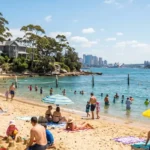
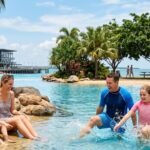
About halfway along the northern foreshore, a side path leads down to one of Sydney’s most distinctive public swimming facilities: Maccallum Pool. This is a 33-metre ocean pool fed by the tidal waters of Sydney Harbour, sitting right at the water’s edge with nothing between the swimmer and the open harbour except a low barrier fence and a lot of extraordinary scenery.
The pool has been here in one form or another since the early nineteen hundreds. Local residents originally constructed a basic rock pool on the foreshore to allow safe swimming away from harbour traffic and the currents that made open-harbour bathing unpredictable. The council formalised the facility and it was later named Maccallum Pool in honour of Hugh Maccallum, a prominent local figure who campaigned for public access to the foreshore. Council took formal ownership of the site around nineteen thirty and improvements — including the distinctive timber deck and changing facilities — were added over subsequent decades.
Today, Maccallum Pool is free and open to the public. The water is harbour water, which means it is saltwater, carries the smell and feel of the open sea, and can be bracing even on warm days. The view from the pool is nothing short of remarkable — you float in Sydney Harbour with the Opera House directly opposite and the Harbour Bridge framing the skyline to your right. It is genuinely one of the great swimming experiences available in any city on earth.
The pool closes periodically for cleaning and maintenance. Closure dates are posted on the gates and on the North Sydney Council website. Check before you go if swimming is a priority for your visit.
Robertson’s Point Lighthouse — The Tip of the Peninsula
Continue along the foreshore path past Maccallum Pool and you will reach the very tip of Cremorne Point, where Robertson’s Point Lighthouse stands on a low rocky headland. This is the turnaround point of the walk — the spot where the foreshore path curves around the end of the peninsula and begins heading back up the other side towards Mosman Bay.
The lighthouse is a compact, functional structure that has guided maritime traffic around this point for well over a century. Unlike many Australian lighthouses which sit on inaccessible cliff tops or remote headlands, Robertson’s Point Lighthouse is completely accessible on foot. You can walk right up to it, sit on the rocks around it, and look back up the harbour in both directions simultaneously. To the east you see the open harbour stretching towards the heads and the Pacific Ocean. To the west, the Harbour Bridge dominates. In every direction, the water is active with ferries, sailing boats, kayakers, and the occasional larger vessel navigating the shipping lanes.
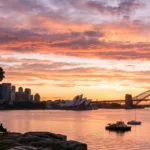
For photographers, this is one of the premier positions in Sydney for capturing both the Bridge and the Opera House in a single frame. The morning light comes from behind you — from the eastern horizon — and falls directly onto both structures, making it a particularly good spot for golden-hour photography in the first hour after sunrise. The evening light is different but equally beautiful, with the western sky behind the Bridge turning orange and pink as the sun sets.
Children, it should be noted, love this spot. There are rocks to scramble, water to watch, boats to count, and the lighthouse itself to examine up close. The footing on the rocks around the base is manageable for agile kids, though supervision is important given the proximity to the water.
The Lex and Ruby Graham Garden — A Love Story in Plants
On the Mosman Bay side of the point, shortly before you reach the Old Cremorne Wharf area, a remarkable garden fills a section of the foreshore that would otherwise be grass and path. The Lex and Ruby Graham Garden is one of Sydney’s most touching public spaces, and most people who walk past it have no idea of the story behind it.
Lex and Ruby Graham were ordinary Sydneysiders who lived in the Cremorne area and spent the better part of four decades creating and tending a garden on public land along the foreshore. Starting in the late nineteen fifties, when Lex was a working man with weekends to fill and Ruby was his devoted partner, they began transforming a scrubby section of the reserve with native and exotic plantings, careful paths, and the kind of sustained horticultural effort that most people direct towards their own private gardens. They worked on it together for the rest of their lives, and after they were gone, local volunteers took over the stewardship, maintaining the garden in the spirit its creators had established.
Today the Lex and Ruby Graham Garden is a place of genuine beauty — lush, shaded, full of interesting plantings at every level from ground cover to canopy, and maintained with the kind of loving attention that no government body could replicate alone. It is a testament to what committed individuals can do for a community over decades of quiet effort. Walking through it, particularly when it is in full growth, feels like passing through somebody’s private garden — intimate, cared-for, alive.
The garden provides a welcome patch of deep shade on hot days, and the benches within it are among the best sitting spots on the entire walk. Dogs tend to enjoy the soft surfaces and interesting smells considerably.
Mosman Bay Foreshore and Old Cremorne Wharf
The final section of the walk follows the Mosman Bay foreshore back towards the starting point. This side of the peninsula has a different character from the open-harbour northern face — the bay is more enclosed, the water calmer, the atmosphere more sheltered. Mosman Rowers Club sits along this stretch, and the sight of rowers going through their morning training on the flat water of the bay is a pleasing slice of Sydney sporting life.
Old Cremorne Wharf is located on this side of the point, and it serves as a stop on the Mosman ferry route. If you have timed your walk to coincide with a ferry departure, you can catch the boat back to Circular Quay from here rather than walking back to the main wharf. Check timetables in advance as the Old Cremorne stop has fewer services than the main Cremorne Point Wharf.
The path from Old Cremorne Wharf back to Cremorne Point Wharf follows the foreshore closely, passing small sandy inlets and the occasional private jetty before returning to the main gateway of the reserve. The full loop, from wharf to wharf and back again, covers approximately three and a half kilometres. Those wishing to extend the walk can continue into the Mosman Bay residential streets and loop back via Bogota Avenue and Hodgson Avenue, adding roughly another kilometre and a half to the journey.
Cremorne Point Walk with Dogs: Everything You Need to Know
One of the most frequently asked questions about the Cremorne Point Walk concerns dogs. The short answer is yes, dogs are allowed throughout Cremorne Reserve and along the foreshore walking path, subject to being kept on a lead at all times. The longer answer is that this is one of the genuinely dog-friendly public spaces in Sydney, with infrastructure to match the welcome.
Doggy bag dispensers are installed at regular intervals along the path, which means you do not need to carry bags from home (though it is always wise to bring your own as a backup in case dispensers are empty). Fresh water stations are positioned at multiple points around the reserve, providing drinking water for both dogs and their owners. The path surface is kind to paws — no rough gravel or sharp surfaces — and the relatively flat terrain means even older or less mobile dogs can complete the full circuit comfortably.
Dog owners who visit regularly tend to time their walks for early weekday mornings, when the path is quiet and dogs can trot at their own pace without negotiating crowds of visitors. Weekend mornings see more traffic — both human and canine — and the social dynamics between dogs can require more attentive management.
The harbour itself presents an obvious temptation for water-loving dogs, and while some areas of the foreshore allow careful access to the water, dogs are not permitted in Maccallum Pool. The pool is a shared facility with human swimmers, and the restriction is sensible and clearly signposted. Keep your dog on the lead as you pass the pool, give swimmers their space, and move on to the rocks around Robertson’s Point where there is more opportunity for supervised water access.
Dogs generally react very well to the walk — the combination of interesting smells, moving water, harbour breezes, and exposure to other dogs and people makes for a highly stimulating excursion. Many dog owners report that their animals return from the Cremorne Point Walk noticeably calmer and better exercised than from most urban walks of comparable length.
The Views: What You Can See from Cremorne Point
It is worth being specific about the views from Cremorne Point, because they are not merely good — they are exceptional in a way that photographs struggle to convey. The combination of elements, the angle of approach, and the 360-degree exposure of the peninsula creates a visual experience that is genuinely difficult to replicate elsewhere around Sydney Harbour.
The Sydney Opera House
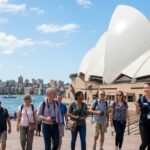
From most points along the northern foreshore and particularly from the area near Maccallum Pool, the Sydney Opera House sits directly opposite across the water. The distance is close enough that the distinctive shell-like sail structures are clearly visible and identifiable, yet far enough that the entire building can be seen in one glance without needing to tilt your head. The Opera House is most photogenic in the morning when the eastern light strikes its white tiles directly, and in the early evening when the setting sun adds gold to its curves.
Sydney Harbour Bridge
The Harbour Bridge is visible along much of the walk, particularly from the northern foreshore and from Robertson’s Point. At certain angles, both the Bridge and the Opera House appear in the same frame — which is the shot that most visitors are trying to capture. From Robertson’s Point, the geometry works particularly well, with the Bridge to the right and the Opera House further along to the left, both sitting against the water and the city behind them.
What is perhaps less expected is the view from below the Bridge — the walk passes relatively close to its northern pylon, and looking up at the steel arch from this angle gives a sense of the structure’s scale that observation decks and tourist photographs rarely convey.
Fort Denison
Fort Denison, the small fortified island that sits in the middle of Sydney Harbour, is visible from several points along the walk. It was originally used as a place of punishment for convicts in the early colonial period — it was known at the time as Pinchgut Island, a name that speaks plainly to its conditions — before being converted into a military fortification in the mid-nineteenth century during concerns about Russian naval incursions. Today it is managed by the NSW National Parks and Wildlife Service and can be visited by guided tour from Circular Quay. From Cremorne Point, it appears as a distinctive silhouette of stone walls and a Martello-style tower against the harbour water.
The City Skyline
The Sydney CBD skyline is visible in panorama from Cremorne Point, with the towers clustered along the ridge appearing over the water in a way that reinforces just how close the north shore sits to the city centre. On clear days, the detail is remarkable — individual buildings are identifiable, cranes marking construction sites are visible, and the thin sliver of Pyrmont Bridge can sometimes be spotted through the harbour haze to the west.
For panoramic photography, this is one of the top five positions in Sydney. The combination of height, angle, and lack of obstruction means wide shots from Cremorne Point regularly appear in travel publications, real estate advertisements, and documentary films about the city.
The History of Cremorne Reserve: Two Hundred Years of Change
Understanding the history of Cremorne Point adds a layer of meaning to the walk that goes beyond the visual spectacle. This small peninsula has been through several distinct identities since European settlement, and traces of each phase remain in the landscape.
First Nations Country
The Cammeraygal people were the traditional custodians of the land around Cremorne Point and the broader north shore area. Archaeological evidence and early colonial accounts record their presence as a seafaring, fishing people who navigated Sydney Harbour with great skill in bark canoes, harvesting the extraordinary marine richness of the estuary. The harbour provided everything they needed — fish were speared or trapped, shellfish collected from the rocky shores, and the fresh water from hillside creeks supplemented what the harbour offered.
The impact of European settlement on the Cammeraygal was catastrophic, as it was for First Nations communities across the continent. Smallpox, displacement, and the systematic destruction of traditional food sources devastated the population within decades of the First Fleet’s arrival. The names of some Cammeraygal people and their encounters with early settlers are preserved in the historical record, but the living culture and language that animated this landscape for thousands of years was all but destroyed in the space of a generation.
Walking through Cremorne Reserve today, it is worth holding this history in mind. The beautiful landscape you are moving through was a homeland long before it was a public park.
The Pleasure Ground Era
In the mid-nineteenth century, Cremorne Point was transformed into a commercial pleasure ground — a forerunner of the modern amusement park. An entrepreneur named Joseph Hughes leased the point from around eighteen fifty and developed it as an entertainment venue called Cremorne Gardens, drawing its name from the famous pleasure gardens of the same name in Chelsea, London.
Cremorne Gardens offered Sydneysiders of the colonial era a ferry ride across the harbour followed by a range of entertainments including picnicking, dancing, theatrical performances, fireworks, and various amusements. The gardens were popular for several decades, drawing visitors from across the colony and establishing Cremorne Point as a destination rather than just a geographical feature. Eventually the lease lapsed and the entertainment business wound up, but not before the name Cremorne had become firmly attached to the area.
The Reserve Era
The land that comprises today’s Cremorne Reserve was gradually converted to public use over the late nineteenth and early twentieth centuries. North Sydney Council took responsibility for much of the foreshore, developed walking paths, constructed Maccallum Pool, and created the network of access points that allow today’s visitors to walk the full circuit of the peninsula. The reserve status has protected the foreshore from residential development and ensures continued public access to one of the harbour’s finest walking routes.
Photography at Cremorne Point: When to Go and Where to Stand
Cremorne Point is one of the most photographed stretches of foreshore in Sydney, and for good reason. The combination of landmark architecture, harbour water, and clear sight lines creates conditions that reward photographers at almost every skill level.
Best Times for Photography
The hour after sunrise is the classic choice for serious photographers. At this time, the light comes from the east and falls directly onto the Harbour Bridge and Opera House from the Cremorne side. The water is often calm in the early morning, giving mirror-like reflections of the city skyline. Harbour traffic is light, and the path is quiet enough that long exposures are possible without pedestrian interruption. The golden-hour quality of the light at this time elevates otherwise ordinary photographs into something considerably more striking.
The evening provides a different but equally compelling opportunity. As the sun sets in the west, it backlights the Harbour Bridge, creating dramatic silhouette effects if that is what you are after. The city lights begin to come on from around dusk, and the period between last light and full darkness — the blue hour — produces some of the most atmospheric images of the harbour skyline.
Midday light is generally the hardest to work with, producing harsh shadows and washed-out tones. Cloud cover improves midday shooting significantly by diffusing the light, so overcast but clear days can actually produce better results than bright sunshine for certain types of shots.
Best Positions Along the Walk
Robertson’s Point at the tip of the peninsula is the premier position for capturing both the Bridge and the Opera House together. The geometry from this spot works better than almost anywhere else around the harbour because the angle creates the right spatial relationship between the two landmarks.
The northern foreshore near Maccallum Pool offers good close-up views of the Opera House across the water. From here, the Opera House fills a larger portion of the frame than from Robertson’s Point, making it better for shots focused on that structure specifically.
The Lex and Ruby Graham Garden provides foreground interest — the lush plantings can be composed into the lower half of a frame with the harbour and city skyline behind. This technique separates Cremorne Point photography from the cleaner but perhaps less textured shots from Robertson’s Point.
The Cremorne Point Walk with Children
The Cremorne Point Walk is genuinely suited to families with children of most ages. The path is mostly flat, paved or compacted, and wide enough that prams and strollers can navigate it comfortably on the main foreshore sections. There are a few short sections with steps, but these are easily managed and signposted.
The playground near Cremorne Point Wharf provides a pre- or post-walk attraction for younger children, and the kiosk at Sophie’s Place serves snacks and drinks that help manage the energy levels of small walkers who feel they have walked quite far enough already. The lighthouse at Robertson’s Point is a hit with most children — it is close enough to touch, surrounded by interesting rocks, and offers views in every direction that make small people feel very high up even though the elevation gain is minimal.
Maccallum Pool is popular with older children and teenagers who have the confidence to swim in a harbour pool environment. The pool has a relatively calm surface — it is tidal but protected from boat wash — and the water temperature is generally pleasant from late spring through autumn.
The ferry journey itself is a significant attraction for many children, particularly those who have not spent much time on boats. The view from the ferry of the Harbour Bridge as you pass beneath it tends to produce strong reactions from young passengers, and the bustle of Circular Quay — with its mix of ferries, train station, restaurants, and street performers — makes for a satisfying beginning or end to the outing.
What to Bring: A Practical Packing List
The Cremorne Point Walk does not require any specialist equipment, but a few items will make the experience considerably more comfortable.
Water: Carry water for everyone in the group, including dogs. While water stations exist in the reserve for dogs, human water access along the walk is limited to the kiosk at the wharf ends.
Sun protection: Much of the walk is exposed to direct sun. Sunscreen, a hat, and sunglasses are advisable for visits between late spring and early autumn. The Australian UV index can be high even on days that feel mild.
Camera or phone: The views justify a charged camera. If you use a phone for photography, make sure it is charged before you leave Circular Quay — the walk will generate more photographs than most urban excursions.
Swimmers: If you intend to use Maccallum Pool, bring a towel and swimmers. The pool has basic changing facilities.
Opal card or contactless payment: Required for ferry travel. Cash is not accepted on Transport for NSW ferries.
Dog leads: Required at all times in the reserve. Dogs are not permitted off-lead in Cremorne Reserve.
Snacks: There is no cafe within the reserve itself (though the kiosk at the wharf is reasonably stocked), so carry food if you plan a longer visit.
When to Visit: Seasons and Weather
Cremorne Point can be visited year-round, and each season has its own character.
Summer (December to February)
Sydney summers are warm to hot, with temperatures regularly reaching the low thirties. The walk can feel exposed in full sun, and Maccallum Pool becomes a major attraction as swimmers arrive early to claim the pool for their morning laps. Summer mornings are the best time to visit in this season — arrive early, complete the walk before ten in the morning, and you will avoid the worst of the heat while catching the best of the harbour light. Carry plenty of water and apply sunscreen generously.
Summer evenings are also excellent — the long daylight hours mean you can do a late afternoon walk and still have good light for photography well past six o’clock. The harbour is busy with pleasure craft in summer, which adds to the visual interest.
Autumn (March to May)
Autumn is arguably the most pleasant season for the Cremorne Point Walk. Temperatures cool from the summer heat to comfortable walking range — typically the high teens to mid-twenties — while the sky often takes on the particularly clear quality that Sydney autumns are known for. The harbour water remains warm enough for swimming at Maccallum Pool through April and into May in most years.
Winter (June to August)
Sydney winters are mild by most standards, with temperatures rarely dropping below ten degrees Celsius even at night. Daytime walking temperatures in winter are typically in the mid-teens, which most people find ideal for sustained walking. The sky is often very clear in winter, providing some of the best visibility and photographic conditions of the year. The pool is quieter — some hardened swimmers use it year-round, but crowds are thin.
Spring (September to November)
Spring brings wildflowers to the native sections of the reserve and renewed growth to the Lex and Ruby Graham Garden. The weather is transitional — some days feel like a continuation of winter, others like early summer — but the increasing warmth and lengthening days make spring an excellent time to visit. The harbour comes to life again after the quieter winter months, with more boats and more activity on the water.
Extending Your Visit: Nearby Walks and Attractions
The Cremorne Point Walk connects well with several nearby walking routes and attractions for those wishing to make a full day of it on the north shore.
Mosman Bay to Taronga Zoo
From Mosman Bay, it is possible to walk or take a short ferry hop to Taronga Zoo, which sits on the hill above the bay. Taronga is one of Australia’s premier zoos, with world-class animal collections and extraordinary harbour views from its upper terraces. Combining the Cremorne Point Walk with a visit to Taronga Zoo makes for a full and varied day out.
Neutral Bay and Kirribilli
On the opposite side of the harbour from Cremorne Point, Kirribilli and Neutral Bay offer additional walking routes, cafes, and the chance to view Admiralty House and Kirribilli House — the Sydney residences of the Governor-General and the Prime Minister respectively. These can be reached by ferry from Cremorne Point Wharf.
Manly Ferry and Coastal Walk
The Manly Ferry from Circular Quay is a longer harbour journey than the Cremorne crossing, taking about thirty minutes each way, and it connects to the famous Manly to Spit Bridge coastal walk — a more demanding but extraordinarily beautiful route along the northern harbour cliffs. This is a full-day excursion and requires appropriate footwear and fitness, but it is one of the great walks in New South Wales.
Accessibility at Cremorne Reserve
The main foreshore path around Cremorne Point is largely accessible for mobility aids, including wheelchairs and prams, on the primary sections of the route. The path is sealed or compacted gravel, wide enough for two people abreast, and the elevation change is minimal on the main circuit.
There are some sections with steps, particularly around the Robertson’s Point Lighthouse headland and at certain connections between the foreshore path and the street-level access points. These sections can be bypassed by taking alternative routes within the reserve, and most of the major viewpoints are accessible without navigating the stepped sections.
The ferry wharf itself is accessible, with boarding ramps that adjust to water level. Transport for NSW provides accessibility information on its website for passengers requiring additional assistance.
Insider Tips: What Regular Visitors Know
- The walk is best on a weekday morning when the path is quiet and parking is marginally easier than weekends.
- The bench near Robertson’s Point Lighthouse is one of the best informal picnic spots in Sydney — flat, sheltered from wind on most days, and positioned with harbour views in three directions.
- If you arrive by ferry and plan to return by ferry, the Old Cremorne Wharf on the Mosman Bay side means you do not need to retrace your steps — you can complete the full loop and catch the boat from the far end.
- Street parking restrictions on Milson Road and surrounding streets change periodically. Read every sign carefully before parking, and budget time to walk from wherever you manage to park.
- Maccallum Pool is best enjoyed on calm days when harbour swell is minimal. After periods of rough weather, the pool can be choppy and less pleasant for swimming.
- The kiosk at Cremorne Point Wharf (Sophie’s Place) serves decent coffee and is a good pre-walk stop. It is not always open at very early hours, so if you are planning a sunrise walk, carry your own supplies.
- The reserve has two main toilet blocks — one near the Cremorne Point Wharf entrance and one on the Mosman Bay side. Both are generally well-maintained.
- Dogs have been known to react to the resident birds in the reserve — there are brush turkeys, kookaburras, rainbow lorikeets, and various wading birds around the foreshore — so keep dogs on a firm lead in areas with heavy bird activity.
- For the best panoramic photograph that includes both the Harbour Bridge and the Opera House, stand at Robertson’s Point and position yourself on the western edge of the rocky headland. The angle from this specific spot is better than from the path itself.
- The reserve has no cafe or food vendor within it (as opposed to at the wharf end), and several visitors have noted wistfully that a small harbourside cafe somewhere along the middle of the circuit would be a marvellous addition. Until that day comes, bring your own supplies.
Cremorne Point Walk vs Other Sydney Harbour Walks: A Comparison
| Walk | Distance | Difficulty | Dog Friendly | Best Feature |
| Cremorne Point Walk | 3.5 km | Easy | Yes — leash on | 360-degree harbour views; dog facilities; free entry |
| Bondi to Coogee Coastal Walk | 6 km | Easy-Moderate | Some sections | Ocean cliffs; rock pools; cafe stops |
| Manly to Spit Bridge Walk | 10 km | Moderate | Yes — leash on | Wild harbour bush; secluded beaches |
| Bradleys Head Walk | 3 km | Easy | Yes — leash on | Close-up harbour views; navy vessels |
| Spit to Manly Walk | 10 km | Moderate | Yes — leash on | Northern beaches; national park bush |
Frequently Asked Questions About the Cremorne Point Walk
How long does the Cremorne Point Walk take?
At a comfortable walking pace, including pausing at the major viewpoints, the full 3.5-kilometre loop takes approximately one to one and a half hours. Those who stop for a swim at Maccallum Pool, spend time at the Robertson’s Point Lighthouse rocks, or linger in the Lex and Ruby Graham Garden should budget two hours or more. With children, allow considerably longer — young children often want to stop frequently, explore rocks, and watch boats, all of which is entirely reasonable given the setting.
Is the Cremorne Point Walk suitable for beginners and elderly walkers?
Yes, this is one of the most accessible harbour walks in Sydney for walkers of varying fitness levels and ages. The main foreshore path is largely flat, paved, and well-maintained. The total elevation gain is minimal — around eleven metres — and the path does not require any specialist footwear or fitness preparation. Elderly walkers, those recovering from injury, and people who do not walk regularly will find the circuit manageable at their own pace. The only sections requiring more care are the short rocky area around Robertson’s Point Lighthouse and a few sets of steps near the Bogota Avenue entrance to the reserve.
Can you swim at Cremorne Point?
Yes. Maccallum Pool is a free public tidal pool on the northern foreshore of Cremorne Point, open to all swimmers. It is a 33-metre pool filled with harbour water, with a basic changing area and a timber deck. There are also small rocky inlets around the foreshore that allow supervised access to the harbour for those who prefer open water. Dogs are not permitted in Maccallum Pool. The pool closes periodically for cleaning — check the North Sydney Council website for current closure dates before visiting if swimming is your primary purpose.
How do you get to Cremorne Point?
The most enjoyable way is by ferry from Circular Quay. The Mosman ferry service stops at Cremorne Point Wharf as its first north-shore stop, and the crossing takes approximately fifteen to twenty minutes. Bus services also run to the Cremorne area. By car, street parking is available on Milson Road and surrounding residential streets, but availability is limited and spaces fill quickly on weekends and during business hours. Opal card or contactless bank card is required for ferry travel.
Is the Cremorne Point Walk free?
Yes, entry to Cremorne Reserve and the walking path is completely free. Maccallum Pool is free to use. The ferry to get there is charged at the standard Transport for NSW ferry rate, which is subsidised and inexpensive. Parking, if required, may incur metered parking costs depending on where you park and for how long.
Are dogs allowed on the Cremorne Point Walk?
Yes. Dogs are permitted throughout Cremorne Reserve and along the foreshore walk on a lead at all times. The reserve provides doggy bag dispensers and water stations specifically for dogs at multiple points along the circuit. Dogs are not permitted in Maccallum Pool, which is reserved for human swimmers. The walk is one of the more dog-friendly public reserves in the inner north shore area, and it is popular with local dog owners throughout the week.
Is there parking at Cremorne Point?
Limited street parking is available on Milson Road and on residential streets immediately above and around the reserve. Parking availability varies considerably by time of day and day of the week. Weekday mid-mornings typically have two or three available spots; weekend mornings can be significantly more competitive. If you are driving, arrive early or be prepared to park some distance from the reserve entrance and walk down. There is no dedicated car park for the reserve.
What is Maccallum Pool?
Maccallum Pool is a heritage-listed tidal harbour pool on the northern foreshore of Cremorne Point Reserve. It is a 33-metre pool fed by Sydney Harbour tidal water, dating in its original form to the early nineteen hundreds. It was formalised by council and named for Hugh Maccallum around nineteen thirty. The pool is free, open to the public, and offers swimming with a view directly across to the Sydney Opera House. It is regarded as one of Australia’s most scenically positioned public pools. It closes periodically for maintenance — check North Sydney Council’s website for current schedules.
Is Robertson’s Point Lighthouse open to the public?
Robertson’s Point Lighthouse is publicly accessible as part of the Cremorne Reserve foreshore walk. There is no formal opening or closing time — it is a navigational structure on a public headland, and visitors can walk right up to the lighthouse and explore the rocks around it during any reasonable visiting hour. The lighthouse is still operational as a maritime navigation aid but does not offer internal tours. The surrounding headland and rocks provide some of the best views available anywhere on Sydney Harbour.
What is the Lex and Ruby Graham Garden?
The Lex and Ruby Graham Garden is a community garden on the Mosman Bay foreshore of Cremorne Point Reserve, created and tended by local residents Lex and Ruby Graham from the late nineteen fifties onwards. The couple worked on the garden for decades, creating a lush and beautifully maintained planting on public foreshore land. After their passing, local volunteers continued their work. The garden is now maintained by the Friends of the Lex and Ruby Graham Garden group and is one of the most visited and appreciated sections of the Cremorne Point circuit.
What can you see from Cremorne Point?
From various points along the Cremorne Point Walk, you can see the Sydney Opera House, Sydney Harbour Bridge, Fort Denison, the central business district skyline, Kirribilli, Lavender Bay, Mosman Bay, and the broader expanse of Sydney Harbour towards the Heads. Robertson’s Point at the tip of the peninsula is the premier viewing position, offering sightlines in multiple directions simultaneously. The view is particularly dramatic at sunrise and in the early evening.
Is there a cafe at Cremorne Point?
Sophie’s Place, a small kiosk and cafe, operates at Cremorne Point Wharf and serves coffee, food, and drinks. It is the main food and beverage option in the immediate area. There is no cafe or food vendor within the reserve itself — a fact that regular visitors note as the one genuine gap in what is otherwise a very complete visitor experience. Visitors planning to spend extended time in the reserve should carry their own food and water.
Can you do the Cremorne Point Walk with a pram?
Yes. The main foreshore path is paved and wide enough for prams and strollers. The primary loop is accessible for most standard prams, though some sections near Robertson’s Point and around the stepped access points at the Bogota Avenue end of the reserve require navigating steps. Most of the walk — and all of the best viewpoints — can be reached without encountering significant obstacles. Parents with prams most commonly report the walk as manageable and well worth attempting.
What is the best time of year to visit Cremorne Point?
Cremorne Point can be visited enjoyably throughout the year. Autumn — from March to May — is widely regarded as the best season, combining comfortable temperatures, clear skies, and harbour water still warm enough for swimming. Winter brings excellent visibility and light for photography, with mild temperatures suitable for walking. Summer visits are best planned for early morning to avoid peak heat. Spring sees the garden at its most lush and colourful.
How do I get from Cremorne Point back to Circular Quay?
Ferries depart from Cremorne Point Wharf on the Neutral Bay side of the point and from Old Cremorne Wharf on the Mosman Bay side. Both stops serve the Circular Quay route, though Old Cremorne has fewer services per day. Check the Transport for NSW Opal app or website for current timetables. The ferry journey back to Circular Quay takes the same fifteen to twenty minutes as the outbound crossing.
Final Thoughts: Why the Cremorne Point Walk Stands Apart
There are harbour walks elsewhere in Sydney that are longer. There are coastal walks that are more dramatic. There are urban parks with better facilities. But the Cremorne Point Walk sits in a category of its own because of how it combines everything — the history, the horticulture, the swimming, the lighthouse, the dog-friendly infrastructure, the extraordinary views, and the simple pleasure of being outside on a public foreshore path with the harbour all around you.
It is the kind of walk that Sydney residents do repeatedly over years and find something new each time — a different light on the Bridge, a different angle on the Opera House, the garden in a different season, a new bench discovered on a quieter section of path. Visitors who discover it tend to remember it as one of the genuinely unexpected highlights of their Sydney trip: a place they found by taking the ferry to a stop most tourists skip, and discovering something remarkable waiting at the other end of a twenty-minute crossing.
If you are in Sydney and you have not walked Cremorne Point, this is the walk to put at the top of your list. Bring your dog, bring your camera, bring your swimmers if the day is warm, and take the ferry from Circular Quay. The walk will take care of the rest.
Quick Reference Summary
| Category | Information |
| Start Point | Cremorne Point Wharf, Milson Road, Cremorne NSW 2090 |
| Loop or One Way | Loop — returns to start point |
| Ferry From | Circular Quay — Mosman Ferry service |
| Key Landmarks | Maccallum Pool, Robertson’s Point Lighthouse, Lex & Ruby Graham Garden, Old Cremorne Wharf |
| Views | Sydney Opera House, Harbour Bridge, Fort Denison, CBD skyline |
| Dogs | On-lead throughout. Bag dispensers and water stations provided |
| Swimming | Maccallum Pool — free tidal harbour pool |
| Cafe | Sophie’s Place at Cremorne Point Wharf |
| Toilets | Near wharf and mid-reserve on Mosman Bay side |
| Entry Cost | Free |
| Best Season | Autumn for all-round conditions; winter for photography |
| Photography Tip | Robertson’s Point at sunrise for Bridge + Opera House in same frame |