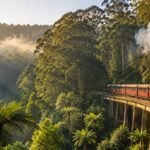
Drive north-east out of Melbourne for about 75 minutes and something shifts. The urban sprawl gives way to rolling green hills. The hills climb into higher country. The road starts winding. Messmate and peppermint gum begin closing in from either side, and then — if you have turned off at Toolangi — the trees become something else entirely. Mountain ash trunks rise past your eye level, past the rooftops, past any comfortable sense of scale, into a canopy that feels more like a cathedral ceiling than a sky. Welcome to Toolangi State Forest.
This is one of the most ecologically significant patches of forest within reach of any Australian capital city. It shelters the Leadbeater’s possum, Victoria’s critically endangered faunal emblem. It contains trees old enough to remember before European settlement. Its gullies are full of cool temperate rainforest that has been quietly doing its own thing for thousands of years, indifferent to the highway humming nearby. And yet it remains, by the standards of well-known natural attractions, relatively unsung.
That suits the people who know Toolangi well. They come back season after season — for the lyrebirds, for the waterfalls, for the camping by the river, for the satisfying physical effort of a long loop walk through wet forest and out again. This guide is written for everyone who has heard Toolangi mentioned and never quite made it there, and for those who have been before and want to go deeper.
Everything covered here — the trails, the wildlife, the history, the camping, the 4WD tracks, the seasonal conditions, the practical logistics — is drawn from on-the-ground research and primary sources specific to this place. Nothing here is generic Australian bush writing dressed up with a different name. Toolangi deserves better than that, and so do you.
Quick Facts: Toolangi State Forest at a Glance
| Detail | Information |
| Location | Sylvia Creek Road, Toolangi VIC 3777 — Central Highlands, Victoria |
| Distance from Melbourne CBD | Approx. 60 km north-east — allow 75–90 minutes driving |
| Review | 4.5 Star |
| Governing Body | Department of Energy, Environment and Climate Action (DEECA) |
| Open Hours | 24 hours a day, 7 days a week, all year |
| Entry Fee | Free. Camping fees apply at managed sites (approx. $6–$7 per vehicle per night) |
| Dogs | Permitted on a leash in State Forest. Not permitted in Murrindindi Scenic Reserve |
| Indicator Plant | Mountain Ash — Eucalyptus regnans (world’s tallest flowering tree) |
| Fauna Emblem | Leadbeater’s Possum — critically endangered, Victoria’s state faunal emblem |
| Forest Type | Tall wet sclerophyll, cool temperate rainforest, riparian zones |
| Traditional Custodians | Taungurung people (primary); Wurundjeri people (southern country) |
| Fire History | Significantly burned in 1939 (Black Friday) and again in parts during 2009 |
| Phone — Parks Victoria | 13 6186 |
| Mobile Reception | Very limited in forest. Download maps and emergency contacts before leaving home |
| Nearest Town for Supplies | Healesville (south, 30 min) or Yea (north, 25 min) |
Where Is Toolangi State Forest and What Exactly Is It?
Toolangi State Forest occupies a stretch of the Central Highlands of Victoria, running from Mount Monda in the south to Murrindindi in the north. The Toolangi township sits roughly in the middle of this corridor, along the Healesville-Kinglake Road. The forest covers the northern slopes of the Great Dividing Range between the Melba Highway (B300) to the west and the Maroondah Highway (B360) to the east.
At its most basic, this is a state forest — public land managed under the Forests Act for multiple uses including recreation, water catchment, conservation, and historically, commercial timber production. Unlike a national park, a state forest can accommodate a broader range of uses. The practical effect for visitors is that access is generally more relaxed, camping is less formalised, dogs are permitted in the forest (though not in the adjacent Murrindindi Scenic Reserve), and you can drive fire trails in appropriate vehicles without restriction.
The forest sits between elevations of roughly 100 metres at its lower valley floors and over 700 metres on the ridgelines. That range matters because it creates genuinely different forest communities within a compact area. On the higher, wetter southern slopes and in the sheltered gullies, you find cool temperate rainforest — ancient myrtle beech and sassafras trees draped in ferns, moss, and lichen. On the open ridges and mid-slopes, tall mountain ash forests dominate, their straight grey trunks rising without a branch for the first 30 or 40 metres. In drier pockets facing north, messmate, peppermint, and grey gum forest replaces the ash.
The result is a forest that rewards attention. Walking through Toolangi is not the same experience at every step. Pay attention to the changes in understorey, the shift in air temperature as you drop into a gully, the change in birdcall from the canopy to the ground — and you realise you are moving through a landscape of genuine ecological complexity.
Taungurung Country: The People Who Have Known This Place Longest
The word Toolangi comes from the Taungurung language. Its meaning has been recorded as ‘stringybark forest’ — a reference to the dominant tall messmate stringybarks (Eucalyptus obliqua) of the lowland areas — though it is also interpreted more broadly as ‘tall trees,’ reflecting the forest’s most defining visual quality. The name is old. It predates every road, every track, every fence post in the district.
The Taungurung people are the primary Traditional Custodians of the country where Toolangi State Forest stands today. To their south, Wurundjeri country begins. Both groups maintained a deep and detailed knowledge of these forests — not as wilderness to be feared or conquered, but as managed country to be read, used thoughtfully, and passed on to the next generation.
The montane forests of the Central Highlands provided an abundance of resources for Taungurung people across the seasons. Wallabies and possums were hunted for meat and skins — brushtail possum pelts sewn together formed cloaks (Gugra) well-suited to the cold and wet conditions of the highland winter. The waterways running through what is now Toolangi were rich with fish, waterbirds, and freshwater crayfish. Mountain pepper (Tasmannia lanceolata) provided flavour. Southern sassafras leaves made a soothing tea. The straight stems of Austral Mulberry served as fire sticks and spear shafts. Every plant species in this forest had a name, a use, a story.
Movement through traditional country was determined by the seasons and the availability of food and materials. The higher altitude country of the Central Highlands was particularly important during summer, when the lowlands became hot and dry. The forest provided shade, reliable water, and the small mammals and insects that retreated to it.
Evidence of long-term occupation lies hidden beneath the deep organic layer of the forest floor — fallen bark, leaf litter, and woody debris that rapidly conceal the artefacts of thousands of years of human use. In areas affected by the 2009 fires, where these layers were stripped back, stone tool scatters and other cultural sites were uncovered in adjacent forests, offering physical evidence of the presence that the landscape’s own name has always announced.
The Taungurung Recognition and Settlement Agreement, which took formal effect in August of 2020, is the formal legal acknowledgement by the Victorian government of the Taungurung people’s rights and connection to their country. For visitors, acknowledging this history is not a formality — it is an honest starting point for understanding what Toolangi is and has always been.
A Forest That Rose from Ash: The 1939 Black Friday Fires and After
To walk through the mountain ash forests of Toolangi is to walk through the living aftermath of one of the most destructive days in Australian fire history. On 13 January 1939 — the day that became known as Black Friday — Victoria burned. Conditions were at the extreme end of what the continent produces: a temperature in Melbourne nudging 46 degrees Celsius, a howling north wind, and humidity so low that the bush was essentially kiln-dried. Hundreds of fires across the state merged, jumped roads, and overwhelmed every attempt at control. Seventy-one people died. Over 1.4 million hectares burned.
The Central Highlands took the full force of it. The mountain ash forests that had stood for a century or more were killed almost entirely. But mountain ash, Eucalyptus regnans, has an evolutionary relationship with catastrophic fire. It cannot regenerate from surviving stems the way most eucalypts can. Instead, it stores seeds in woody capsules in the canopy that are triggered to release by fire heat. The ash-bed left by an intense fire creates the precisely nutrient-rich, competition-free seedbed that the tiny seeds need to establish. Within weeks of the 1939 fires, millions of mountain ash seedlings emerged from the blackened soil.
What grew from that mass germination event is the forest you walk through today. The mountain ash cohort that covers much of Toolangi State Forest is essentially the same age — all of it established from that single post-fire regeneration. Walking through the forest, you are surrounded by trees that are contemporaries, all growing together toward old age at roughly the same rate.
This matters enormously for conservation. Mountain ash only begins forming the large, deep hollows that hollow-dependent animals need when individual trees are very old — typically over 120 years, and most productively at 200 years and beyond. The 1939 cohort is now entering that critical developmental window. The formation of hollows is just beginning. Any further large-scale fire or logging that removes these trees before they complete their ecological maturity could eliminate the hollow resource for hollow-dependent species across a vast area of habitat, with effects that would take centuries to reverse.
Parts of the Toolangi area were burned again in the Black Saturday fires of 2009, adding another layer of complexity to the forest age structure. Some patches that survived both events contain genuinely old-growth trees — the Kalatha Giant being the most famous. These survivors represent what the forest will eventually become, if given the time.
Complete Walking Trails Guide: Every Track in Toolangi State Forest
Walking is how most visitors connect most deeply with Toolangi. The trail network covers a genuine range — from a 20-minute accessible boardwalk suitable for prams through to multi-kilometre summit climbs that demand proper boots and a full day. The main trail access road is Sylvia Creek Road, which branches off Myers Creek Road. It is unsealed gravel, generally suitable for two-wheel-drive vehicles in dry conditions, but demanding with care after rain.
The Wirrawilla Rainforest Walk — The Must-Do Short Walk
Distance: 700 metres return. Duration: 20 to 40 minutes. Difficulty: Easy. Fully accessible boardwalk.
If you have time for only one thing at Toolangi, this is it. The Wirrawilla Rainforest Walk takes you into a pocket of cool temperate rainforest in the headwaters of Sylvia Creek — a forest type that is genuinely rare and irreplaceable. The walk uses a wide, non-slip boardwalk with handrails throughout, making it accessible to pushers, wheelchairs, and anyone who is not comfortable on uneven ground. The boardwalk elevation above the forest floor is deliberate: it protects the extraordinarily fragile root systems of the myrtle beech trees from compaction.
The dominant trees here are ancient myrtle beech (Nothofagus cunninghamii) and southern sassafras (Atherosperma moschatum). Neither is a eucalypt — both belong to southern hemisphere families with origins in the ancient supercontinent of Gondwana. Their canopies are dense and layered, keeping the understorey in a state of perpetual cool, moist shade regardless of what the weather is doing overhead. Every surface is covered. Mosses carpet the ground, climb the trunks, and drape from branches. Lichen forms grey-green rosettes on every exposed piece of bark. Ferns of a dozen species fill every gap between the bigger plants.
The soundscape on a quiet morning is extraordinary. The creek runs over stones somewhere below the boardwalk. Lyrebirds call from the dense understorey — their mimicry creating a shifting, slightly surreal audio collage of other forest birds interleaved with sounds from decades past. This is one of those walks where moving slowly and stopping often returns far more than walking briskly to the end and back.
The car park for Wirrawilla is accessed via Sylvia Creek Road. From the Wirrawilla Rainforest Walk car park, the Myrtle Gully Circuit and the Tanglefoot Loop can also be accessed, making it a natural hub for a longer day in the forest.
The Kalatha Giant Tree Walk — Standing Beside History
Distance: 500 metres loop. Duration: 20 minutes. Difficulty: Easy with a short descent to the gully.
The Kalatha Giant is a single tree, and the walk exists entirely to bring you to it. That might sound like a modest premise, but the tree earns it completely. The Kalatha Giant is a mountain ash (Eucalyptus regnans) that has survived both major fires and commercial logging — a survivor in the fullest sense. It stands 65.5 metres tall. Its girth at the base is 13.85 metres. Its estimated volume is 200 cubic metres of timber. By volume, it is the seventh largest tree in Victoria. Its age is estimated at somewhere around 400 years.
Standing at the base of the Kalatha Giant recalibrates something in the brain. The 1939 cohort of mountain ash you have been walking through is impressive — but these trees are in their mid-eighties and have perhaps another 300 years of growth ahead of them before they reach the age of the Kalatha Giant. This tree was already 200 years old when Captain Cook arrived on the east coast of Australia. It was already ancient when the first European settlers pushed into the Central Highlands. The scale of its existence makes normal human time references feel slightly absurd.
The walk descends into the gully to reach the tree via a short track with some steps. The surrounding forest in the gully is also notably old, with large-diameter stems and a multilayered canopy that creates deep shade even in midsummer. From the return path, look for the dramatic buttressing at the tree’s base — the spreading root flanges that mountain ash develop as they age, giving the trunk a rippled, finned appearance at ground level.
The Kalatha Giant Tree Walk was built using funds from the Victorian Bushfires Appeal Fund following the 2009 fires. It was officially opened on National Tree Day — a fact that feels appropriately symbolic.
The Tanglefoot Loop — The Classic Half-Day Walk
Distance: 10 km return. Duration: 3.5 to 4.5 hours. Difficulty: Moderate. Short steep sections. Solid boots essential.
The Tanglefoot Loop is Toolangi’s signature walk — the one that most visitors who come for a proper day in the bush choose, and the one that most often converts casual visitors into people who come back. It begins at the Tanglefoot Picnic Area, which has picnic tables, a wood-fired BBQ, and toilets — a comfortable staging point before you head into the forest proper.
The name Tanglefoot is earned. The undergrowth in sections of this walk reaches into the track, particularly in wetter months. Fallen branches lie across the path. The ground can be slippery after rain. Proper hiking boots are the minimum sensible footwear — trail runners are acceptable in dry conditions, but sandals and casual shoes will cause problems.
The trail descends from the picnic area into the Sylvia Creek valley, winding through the 1939 mountain ash regrowth forest. The trees here are substantial — straight, tall, their grey-green bark shedding in long ribbons, their canopies far overhead. The understorey changes as you descend: more tree ferns (Dicksonia antarctica grow particularly dense in the gully floors), more mossy logs, more of the moist-ground species that indicate the proximity of permanent water.
Several timber bridges cross Sylvia Creek at various points, and the sound of running water accompanies much of the lower section of the walk. On the return leg, the track climbs back through a different angle of the forest, offering changed views and different vegetation character. The walk circuits back to the Tanglefoot Picnic Area for a well-earned rest at the BBQ.
For navigation: some trail junctions have been noted by walkers as under-signed. Download a trail map to your phone before departure or carry a printed copy. Do not rely on mobile reception for navigation in the forest.
The Myrtle Gully Circuit — Rainforest Immersion Loop
Distance: 9 km loop. Duration: 3 to 3.5 hours. Difficulty: Moderate.
The Myrtle Gully Circuit connects to the northern end of the Tanglefoot Loop and can be walked independently or combined with it for a more substantial day. The 9-kilometre loop passes through the richest of Toolangi’s cool temperate rainforest sections, with boardwalks over sensitive ground, multiple creek crossings, and sustained forest immersion that most walkers find genuinely restorative.
Myrtle Creek itself is the centrepiece of the lower sections — a permanently flowing stream with clear water running over mossy stones, surrounded by the distinctive dark green of myrtle beech canopy. The section near the creek crossing is one of the most photographed in the forest, particularly in the morning when mist hangs in the gully and the light filters through the beech canopy in pale columns.
The circuit works well as a stand-alone walk starting from the Wirrawilla car park, which places you close to the rainforest sections from the outset. Combining it with the Wirrawilla Rainforest Walk (adding roughly 40 minutes) and the Kalatha Giant Tree Walk (adding 20 minutes) creates a full day’s programme covering the best of what Toolangi’s trail network offers.
The Yea River Walk — Easy Half-Hour from the Township
Distance: 4 km loop. Duration: 1 hour. Difficulty: Easy.
The Yea River Walk begins behind the Toolangi Forest Discovery Centre, on the northern side of the main road. It is the most accessible introduction to the forest for visitors who arrive via the township rather than via Sylvia Creek Road. The walk passes through messmate, narrow-leafed peppermint, and mountain grey gum forest in its earlier sections, transitioning into mountain ash as it approaches the river.
The Yea River here is a young river — it rises on the slopes of Mount St Leonard nearby and eventually drains north into the Goulburn River and then the Murray. The viewing platform along the walk gives a direct look at the watercourse, which holds platypus, various fish species, and the aquatic insects and frogs that are the base of a healthy freshwater food web. Platypus sightings are not guaranteed but are far from rare — dawn and dusk are the best windows, and the key is moving quietly and stopping at the water’s edge.
The Sculpture Walk — Art Embedded in the Bush
Distance: 3 km loop. Duration: 45 minutes. Difficulty: Easy.
Also beginning from the Toolangi Forest Discovery Centre, the Sculpture Walk combines a bush walk with an open-air gallery. The trail was first created following an international sculpture event held at Toolangi in 1996, when artists from across Australia and the Asia-Pacific region were invited to create site-specific works in the forest. The sculptures that remain are deliberately integrated with their environment — many have weathered and aged, acquiring their own patina of moss and oxidation that makes them feel less imposed upon the landscape and more grown into it.
The walk is not primarily a natural history experience, but the bush quality of the lower sections is genuine, and several of the sculpture placements have excellent forest backdrops. It makes a good complement to the Yea River Walk for visitors based at the township.
The Wilhelmina Falls Walk — Murrindindi’s Waterfall Reward
Distance: 4 km return. Duration: 1.5 hours. Difficulty: Moderate to hard in sections.
Technically within the Murrindindi Scenic Reserve rather than the state forest proper, the Wilhelmina Falls Walk is a logical extension of any visit to the northern end of the Toolangi area. The walk departs from the Wilhelmina car park on Murrindindi Road, crosses the Murrindindi River on a suspension bridge, and follows a signed track to a viewing platform above the falls. The return route via Grassy Flats varies the experience.
The falls themselves are most impressive in winter and spring, when the Murrindindi catchment is carrying its highest flows. By late summer they reduce significantly, though the walk retains value for forest quality and the suspension bridge crossing. Steel chain handrails have been installed on the steeper and more exposed sections. Wet-weather visits require care on the stony final descent.
Mount Tanglefoot Track — Summit Challenge for Fit Walkers
Distance: Variable — typically 6–10 km return. Duration: Half to full day. Difficulty: Hard. Steep, loose, remote.
Mount Tanglefoot rises above the forest in the western part of the Toolangi area and offers summit views that encompass an extraordinary sweep of Victorian geography. On a clear day the panorama includes the Yarra Ranges, the Strathbogies, the Baw Baw Plateau, and — in exceptional conditions — Port Phillip Bay, the You Yangs, and the Macedon Ranges. The track climbs steeply from Monda Road, passing through temperate rainforest gullies and open ridge-top bush before the final exposed approach to the summit.
This is not a walk for casual footwear or anyone unfamiliar with navigation in forest terrain. The track is loose and rocky in sections. Fallen trees can obstruct the path without notice. Full hiking kit, a map, and a personal locator beacon are appropriate for this one.
The Blue Mountain Ascent and Blowhard Range Walk
For visitors who want to move further from the main tourist trail, both the Blue Mountain Ascent (6 km, 1.5 hours, good views across the Yarra Valley) and the Blowhard Range Walk (6 km, 1.5 hours, views toward Mount Sugarloaf and the Dandenong Ranges) offer worthwhile alternatives. Both involve more exposure to the forest’s working character — fire trails, former logging roads, regrowth sections — alongside the scenic rewards.
Murrindindi River Walk — Cascades and River Scenery
Distance: Variable point-to-point. Duration: 2 to 3 hours one way. Difficulty: Moderate.
Beginning from the Cascades Picnic Area on Murrindindi Road, this walk follows the Murrindindi River upstream through tall forest and ferny gullies, crossing footbridges at several points. The Murrindindi Cascades — a series of falls and rapids over dark basalt rock — are the highlight. In winter and after significant rain they are among the most photogenic waterfalls in the Central Highlands. The walk continues past the Water Gauge Picnic Area and SEC Camp to the Suspension Bridge day area.
All Toolangi Trails at a Glance
| Trail Name | Distance | Duration | Grade | Key Highlights |
| Wirrawilla Rainforest Walk | 700 m rtn | 20–40 min | Easy | Boardwalk, myrtle beech rainforest, accessible for all |
| Kalatha Giant Tree Walk | 500 m loop | 20 min | Easy | 400-year-old mountain ash, 65.5 m tall, gully ferns |
| Tanglefoot Loop | 10 km rtn | 3.5–4.5 hrs | Moderate | Fern gullies, Sylvia Creek bridges, regrowth forest |
| Myrtle Gully Circuit | 9 km loop | 3–3.5 hrs | Moderate | Cool temperate rainforest, boardwalks, creek crossings |
| Yea River Walk | 4 km loop | 1 hr | Easy | Platypus habitat, river views, varied forest types |
| Sculpture Walk | 3 km loop | 45 min | Easy | Outdoor art in forest, starts at Discovery Centre |
| Wilhelmina Falls Walk | 4 km rtn | 1.5 hrs | Mod–Hard | Waterfalls, suspension bridge, Murrindindi Reserve |
| Mount Tanglefoot Track | 6–10 km rtn | Half–full day | Hard | Summit panoramas, remote rainforest, rocky terrain |
| Blue Mountain Ascent | 6 km rtn | 1.5 hrs | Moderate | Yarra Valley views, regrowth forest character |
| Blowhard Range Walk | 6 km rtn | 1.5 hrs | Moderate | Dandenong Ranges vista, former logging routes |
| Murrindindi River Walk | Variable | 2–3 hrs | Moderate | Murrindindi Cascades, footbridges, riverside tall forest |
Wildlife of Toolangi State Forest: What Lives Here and Where to Find It
The combination of old-growth pockets, maturing 1939 regrowth forest, cool temperate rainforest gullies, and permanent waterways creates a mosaic of habitat types that supports exceptional biodiversity. Toolangi is formally recognised by DEECA as supporting critically endangered species and is subject to ongoing wildlife surveys by volunteer groups and government researchers. Here is who lives here.
Leadbeater’s Possum — Victoria’s Endangered Icon
The Leadbeater’s possum (Gymnobelideus leadbeateri) is a small, swift, grey-brown marsupial with a distinctive dark stripe running from forehead to rump. It weighs around 130–160 grams. It moves through the canopy in rapid bursts, pausing on a branch for a fraction of a second before disappearing again. It was declared extinct in 1898. It was rediscovered near Marysville — not far from Toolangi — in 1961, causing one of Australia’s great wildlife conservation moments. It is now Victoria’s state faunal emblem, and it is critically endangered.
The possum’s ecological requirements are precise and demanding. It needs two things simultaneously: a dense understorey of wattle scrub for foraging on wattle sap, honeydew, and invertebrates; and large old-growth hollow-bearing trees for communal denning. A colony uses multiple tree hollows, sometimes 18 to 20 dens within its home range. Remove either element and the colony collapses.
Toolangi State Forest sits at the heart of the possum’s remaining range. Volunteer organisations — particularly Wildlife of the Central Highlands (WOTCH) — conduct regular spotlighting and infrared camera surveys throughout the forest, identifying and recording colonies and advocating for logging exclusion buffers around confirmed sightings. The effort has protected hundreds of hectares of critical habitat.
Seeing a Leadbeater’s possum in the wild is not easy. They are nocturnal, fast, and genuinely rare. Your best chances are in older sections of forest with large standing dead or hollow-bearing trees, in the two hours after dark, moving quietly and scanning the canopy with a torch. Joining a guided wildlife survey with WOTCH or a local eco-guide gives the best odds. Alternatively, Healesville Sanctuary holds Leadbeater’s possums in conditions close enough to wild that watching them there is a genuine experience.
Greater Glider — Night Flyer of the Tall Forest
The greater glider (Petauroides volans) is the largest gliding marsupial in the world and shares the Leadbeater’s possum’s dependence on old-growth hollow-bearing trees. It glides silently between mountain ash canopies on moonlit nights, its gliding membrane catching the light. Greater gliders are listed as vulnerable to extinction and have experienced dramatic population declines in the Central Highlands following the 2009 fires and ongoing loss of hollow-bearing trees.
Spotlighting for greater gliders at Toolangi on a calm, clear night is one of the most atmospheric wildlife experiences available in Victoria. Their eyes reflect torch light brilliantly with a distinctive orange glow, and they are less skittish than the Leadbeater’s possum — they will often hold still and observe you for long seconds before gliding away.
Superb Lyrebird — The Forest’s Master Performer
The superb lyrebird (Menura novaehollandiae) is the ecological engine of Toolangi’s fern gullies. It is simultaneously one of Australia’s most remarkable vocal mimics and one of its most important ecological engineers — males excavate enormous quantities of leaf litter and soil while foraging, in a process equivalent to significant mechanical soil turnover across their territory.
The lyrebird’s song is extraordinary. A breeding male builds a vocabulary of dozens of other species’ calls and weaves them into extended performances that can run for minutes at a time, punctuated by his own distinctive mechanical rattling and churring. The mimicry is precise enough to fool the species being imitated. In forests like Toolangi, where lyrebirds have lived alongside chainsaws and machinery for decades, some individuals include industrial sounds in their repertoire — an unsettling reminder of the forest’s modern history carried in living memory.
Lyrebirds are most vocal in winter (their breeding season) when males display from raised mounds in the fern gullies. The Wirrawilla and Myrtle Gully areas are reliable listening spots in winter. Moving slowly and listening from a fixed position is far more effective than walking briskly and hoping to flush one from cover.
Other Notable Wildlife
Beyond the three headline species, Toolangi’s fauna list rewards patient and observant visitors.
| Species | Notes |
| Platypus | Present in the Yea River and Murrindindi River. Best chance at the Yea River viewing platform at dawn or dusk |
| Mountain Brushtail Possum | Common around campgrounds and picnic areas after dark. Often bold around human food — do not feed |
| Sugar Glider | Small glider with pale belly. Regularly encountered on guided spotlighting walks in mixed eucalypt forest |
| Sooty Owl | Threatened species under Victoria’s Flora and Fauna Guarantee Act. Dependent on tall closed forest — heard more often than seen |
| Gang-gang Cockatoo | Distinctive creaking, cork-pulling call from the upper canopy. Unmistakable grey-and-red male |
| Yellow-tailed Black Cockatoo | Large, conspicuous groups feeding on hakea and banksia. Their contact calls carry a long way |
| Superb Fairy-wren | Common in shrubby understorey edges and clearings. Males brilliant blue in breeding season |
| Flame Robin | Males striking orange-red. Visits from higher altitudes in winter to forest edges and open areas near Toolangi |
| Wedge-tailed Eagle | Regularly seen riding thermals above ridgelines. Largest bird of prey in Australia |
| Brown Trout | Present in Murrindindi River. Victorian Recreational Fishing Licence required to fish |
| Rainbow Trout | Also present in Murrindindi River — a popular river-side fishing destination for licence-holders |
| Eastern Grey Kangaroo | Common in clearings and forest edges at dawn and dusk. Larger mobs at the forest margins |
| Swamp Wallaby | Dense-understorey specialist. Frequently encountered on all forest walking trails |
| Lace Monitor | Large goanna occasionally encountered crossing forest tracks, particularly in warm weather |
The Plants of Toolangi: Understanding What You Are Looking At
Most visitors to an Australian forest walk past most of the flora without knowing what they are seeing. Toolangi’s plant communities are sufficiently distinctive that learning even a handful of species transforms the walk from a generic bush experience into something much more specific and satisfying.
Mountain Ash — Eucalyptus regnans
The mountain ash is the reason Toolangi exists as a destination. It is the world’s tallest flowering plant — not the tallest tree overall (that distinction belongs to a Californian redwood) but the tallest broadleaved flowering tree on earth. Confirmed specimens over 90 metres have been recorded in Victorian forests. The Toolangi trees of the 1939 cohort are now in their 80s, reaching heights between 60 and 80 metres in good growing conditions. The bark is distinctive: fibrous at the base, then smooth and white-grey above the first 10–15 metres, shedding in long ribbons.
Myrtle Beech — Nothofagus cunninghamii
The dominant tree of the cool temperate rainforest, myrtle beech is a southern hemisphere species whose family origins go back to Gondwana. Its small, rounded, dark green leaves create a dense canopy that filters even bright sunshine into something soft and diffuse. Old beech trees develop deeply grooved, dark grey bark encrusted with mosses and lichens. Their fallen trunks become ‘nurse logs’ — nursery beds where the next generation of rainforest plants establish themselves in the decaying wood.
Southern Sassafras — Atherosperma moschatum
The other key rainforest tree in Toolangi’s gullies, southern sassafras is recognisable by its aromatic bark (crush a small piece between your fingers and the spicy scent is immediate), its pale smooth trunk, and the distinctive two-tone appearance of its leaves — dark green above, silver below. A common companion to myrtle beech in the cooler, wetter gully systems.
Soft Tree Fern — Dicksonia antarctica
The tree fern is the most immediately recognisable plant in the gully understorey — the classic ‘fern gully’ image. Dicksonia antarctica grows a fibrous brown trunk up to several metres tall, topped with a crown of long arching fronds. It is one of the slowest-growing plants in the forest — a trunk of one metre height may represent 50 years of growth. This makes it both ancient and irreplaceable. Photographing tree ferns looking upward through the fronds toward the mountain ash canopy is one of the signature images of Victorian highland forests.
Mountain Pepper — Tasmannia lanceolata
A small shrub with lance-shaped leaves and dark berries, mountain pepper is found throughout the wetter forest areas of Toolangi. Both leaves and berries carry a genuine heat — not capsaicin like chilli, but a distinct peppery compound that builds quickly. It was used by Taungurung and Wurundjeri people as a flavouring and is now cultivated as an Australian native food ingredient in commercial kitchens across the country.
Camping at Toolangi: Every Option Explained
Spending a night at Toolangi is not the same experience as a day trip. The forest changes after dark. The lyrebirds fall silent and the nocturnal mammals become active. The creek sound that was pleasant background noise becomes the dominant feature of the soundscape. Morning mist fills the gullies in a way that no daytime photograph captures. For anyone who wants to know the forest properly, staying overnight is essential.
Walindjerri Camp — Mountain Ash and Redwoods Together
Walindjerri Camp sits within the state forest itself, accessible via Sylvia Creek Road. The name was given by the Taungurung people — it means ‘giants’ — and it refers to the two giant tree species that meet at this site: the mountain ash, native to Victoria and the world’s tallest flowering plant, and the California redwood (Sequoia sempervirens), planted during an era of experimental forestry. The pairing is botanically incongruous and visually striking.
The camp is a genuine bush experience — it is not a caravan park or a powered site. What you get is a cleared area in tall forest with a bush toilet and basic facilities. Bring everything you need. The proximity to the walking trails makes it an ideal base for a multi-day forest exploration.
Murrindindi Scenic Reserve — Riverside Camping under Mountain Ash
For families or those who prefer more developed facilities, the Murrindindi Scenic Reserve to the north offers over seven riverside campsites along the Murrindindi River. These are first-come, first-served sites at approximately $6–$7 per vehicle per night. Payment is via an honesty box system at most sites — bring exact change or small notes.
The sites range from basic (pit toilet, fireplace, picnic table) to one site that boasts flushing toilets — an amenity that becomes remarkably appealing after a night in the bush. All are situated in tall mountain ash forest alongside the river, and the sound of the Murrindindi is a constant companion.
The Murrindindi Cascades are a short walk from the main camping area — a series of stepped waterfalls over dark rock that are at their most impressive in winter and spring. The walking tracks through the reserve, including the Wilhelmina Falls Walk, can be done directly from camp.
Important: dogs are not permitted anywhere in the Murrindindi Scenic Reserve. If you are travelling with a dog, you must use Walindjerri Camp or other state forest sites where dogs are allowed on a leash.
Toolangi Recreation Reserve — Township Option
Located 400 metres north off the Healesville-Kinglake Road near the Toolangi primary school, the Toolangi Recreation Reserve offers a more developed camping option within the township itself. Facilities include flush toilets, electric BBQs, and a covered picnic area. It retains a bush feel despite its location, thanks to the tall mountain ash surrounding the reserve. Tank water is available for washing but bring your own drinking water. The reserve is maintained by a volunteer committee — leave it better than you found it and consider making a donation toward its upkeep.
Toolangi Springwater Forest Camp — Private Property Option
For those who prefer a private property camping experience with some added comforts, Toolangi Springwater Forest Camp (available via Hipcamp) sits on six acres among tall trees with a natural spring-fed pond. It is close to the state forest trails and appeals particularly to those who want a more intimate bush setting without the full austerity of public bush camping. Check current availability and details directly with the host.
Two Hills Camping Area
In the northern sector of the state forest, Two Hills Camping Area offers a quieter, more remote option. It is a reasonably level gravelled clearing on a broad ridge, shaded by peppermint and messmate with a low understorey of scrub and bracken fern. Suited to those who are specifically interested in the forest’s more off-track character.
Camping Facilities Comparison
| Campsite | Toilets | Fires | Dogs | Key Feature |
| Walindjerri Camp | Bush toilet | Check restrictions | Yes — leashed | Mountain ash + redwoods; close to trails |
| Murrindindi Scenic Reserve (7+ sites) | Pit toilets (1 flushing) | Fireplace at most sites | No dogs | Riverside sites; Murrindindi Cascades nearby |
| Toolangi Recreation Reserve | Flush toilets | Built fireplace (check bans) | Yes — controlled | Township location; BBQs, covered picnic area |
| Toolangi Springwater Forest Camp | Yes (private) | CFA regulations apply | Check with host | Natural spring pond; private and peaceful |
| Two Hills Camping Area | Basic | Check restrictions | Yes — leashed | Quieter, more remote feel in northern forest |
4WD and Mountain Biking at Toolangi State Forest
Toolangi is one of the most popular 4WD destinations within 90 minutes of Melbourne. The forest’s network of unsealed tracks ranges from well-graded fire roads easily managed by any conventional four-wheel-drive to genuinely technical terrain that will test experienced drivers and their vehicles. Mountain bikers, trail bike riders, and horse riders use the same network, giving the forest a character of active outdoor recreation alongside the walking trails and camping areas.
4WD Tracks
The track network in Toolangi varies dramatically with the weather. What is a comfortable gravel drive in dry summer conditions becomes a wheel-deep mud challenge after winter rain. The Central Highlands receive significant rainfall — the mountain ash forests require it — and that moisture stays in the clay-based soils for long periods. If you are heading out after wet weather, check conditions carefully and understand that getting bogged in Toolangi is genuinely possible if you push into the more technical back-country tracks without appropriate gear.
Lyndalls Track and Blowhard Road are generally recommended as easier entry points for drivers building their off-road confidence. The deeper forest tracks — particularly those heading into the areas north toward Murrindindi and east toward the Black Range — are more challenging, involving steep sections, narrow single-track width, and the constant possibility of fallen trees across the path. Never attempt technical back tracks alone. Always carry recovery gear including a snatch strap, shovel, and tree saver. Let someone know your planned route and expected return time.
Sylvia Creek Road itself — the main access road to the walking trail car parks — is unsealed gravel and can be rough after rain. Most conventional two-wheel-drive vehicles can manage it in dry conditions, but after heavy rainfall the corrugations and loose gravel make it more demanding.
Mountain Biking
Toolangi’s fire trail network makes excellent mountain biking country. The variety of terrain means it suits multiple ability levels: for beginners or those building confidence, the drier fire trails in summer offer wide, well-defined paths through impressive forest scenery without technical demands. For more experienced riders, the undulating terrain, narrower tracks, and variable surfaces that come with Toolangi’s more remote sections provide real challenge.
The forest floor in wet conditions will test even experienced riders — the clay-based soil turns slick, and the combination of tree root exposure, leaf litter, and gradient requires constant attention. Carrying a basic repair kit, carrying enough water for the full planned route, and not riding technical sections alone are all sensible protocols.
Horse Riding
The fire trail network accommodates horse riders and has a history of equestrian use in the area. Riders typically access the forest from nearby properties and agistment facilities. Groups should coordinate with DEECA regarding any current track closures or restrictions before planning a ride through the forest.
CJ Dennis and the Literary History of Toolangi
Toolangi has a cultural history that surprises most visitors. The Australian poet Clarence Michael James Dennis — universally known as CJ Dennis or simply ‘Den’ — first came to Toolangi on a camping trip in 1908. He was immediately captivated. Within a few years, Toolangi became his permanent home, and he lived there for most of the remaining three decades of his life.
Dennis is best remembered for The Songs of a Sentimental Bloke, published in 1915, which became one of the most widely read works of Australian verse ever produced. Written in the vernacular dialect of a working-class Melbourne larrikin navigating love and life, it was an immediate sensation — three editions in its first year, nine in the second, and eventually over 285,000 copies across editions in Australia, England, the United States, and Canada. Den wrote much of this work at and around Toolangi.
His home, which he called ‘Arden,’ became a gathering place for literary figures of the era. In 1935 — just three years before Den’s death — the English Poet Laureate John Masefield visited Arden. To mark the occasion, Dennis planted a copper beech tree in Masefield’s honour. That tree still stands today in the gardens that were once Arden’s grounds, a magnificent specimen overlooking what remains of the property.
The Singing Gardens of CJ Dennis — accessible from the Healesville-Kinglake Road — preserve something of Arden’s character and have operated as a garden and tearoom destination for many decades. The first CJ Dennis Poetry Festival was held in connection with the site and has been an annual event since. The Forest Discovery Centre and the Toolangi water tank murals along the Dindi Arts Trail also reference Dennis’s legacy and his connection to the forest that inspired so much of his writing.
For visitors with any interest in Australian literary history, the CJ Dennis connection adds a layer to Toolangi that few other state forests can match. Walking in country that inspired one of Australia’s best-loved poets, among trees that were already old when he camped beneath them, carries a particular weight.
When to Visit Toolangi: Seasonal Guide
Toolangi State Forest is open all year and offers different rewards in every season. Understanding what each season delivers helps you match your visit to what you most want from it.
| Season | Typical Temps | Conditions & Access | Best For |
| Spring (Sep–Nov) | 12–22°C | Waterfalls running strongly. Wildflowers on ridges. Tracks may still be muddy in Sep. Generally excellent. | Wildflower photography, lyrebird calling, waterfall walks, comfortable camping |
| Summer (Dec–Feb) | 18–30°C | Driest season. Track access at its easiest. Fire danger — check restrictions. River swimming possible. | 4WD access, long walks, mountain biking, river fishing, family day trips |
| Autumn (Mar–May) | 8–20°C | Golden light in the canopy. Fewer crowds. Morning mist in gullies. Excellent photography season. | Landscape photography, atmospheric camping, fungi spotting, quiet walks |
| Winter (Jun–Aug) | 2–12°C | Snow possible on high ground. Waterfalls at peak. Lyrebirds displaying. Cold nights. Tracks can be very muddy. | Lyrebird spotting, Wilhelmina Falls, misty forest photography, very few crowds |
Fire Danger Periods apply during the warmer months. During declared Total Fire Ban days, no fires of any kind are permitted — including campfires and gas stoves without enclosed flames. Check the Vic Emergency app (download it before you go), the CFA website, or call 1800 240 667 before heading out in summer or early autumn. Having a plan for leaving the forest quickly if conditions deteriorate is not excessive caution — it is basic common sense in Australian forest country.
How to Get to Toolangi State Forest
By Car from Melbourne
Follow the Eastern Freeway to the Maroondah Highway, heading north-east through Lilydale, Coldstream, and Healesville. From Healesville, follow the Maroondah Highway north briefly, then turn left onto Myers Creek Road. Sylvia Creek Road branches right off Myers Creek Road, leading to the main trail car parks. Allow 75–90 minutes from Melbourne CBD under normal traffic conditions.
An outstanding alternative or return route follows the Black Spur Drive — the stretch of the Maroondah Highway between Healesville and Narbethong — back south. This section of road winds through some of the finest mountain ash forest in Victoria and is beautiful in any season.
By Public Transport
There is no regular public transport service from Melbourne to Toolangi. The closest train is the Lilydale line, and bus connections from Lilydale to Healesville operate on limited days. From Healesville, no regular public service continues to Toolangi. Car-pooling through walking clubs, conservation groups, or organised tour departures from Melbourne are the practical alternatives for non-drivers.
Nearby Supply Points
- Healesville — 30 minutes south via Myers Creek Road. Full supermarket, petrol, cafes, restaurants, Healesville Sanctuary
- Yea — 25 minutes north via Murrindindi Road. Supermarket, petrol, rural services
- Toolangi township — Ecology Cafe at the Forest Discovery Centre (volunteer-run; check hours before making it a specific destination)
Complete Packing List for Toolangi State Forest
Day Walk Essentials
- Solid lace-up hiking boots with ankle support — the ground is uneven and can be muddy
- Waterproof jacket and a warm mid-layer — gully temperatures can be 10 degrees below the open ridge
- At least 2 litres of water per person — no potable water on most trails
- High-energy snacks and a proper lunch — no food available in the forest
- Sunscreen and insect repellent — both apply even in the forest, particularly at edges
- Downloaded trail map or GPS app loaded offline — mobile reception is unreliable throughout
- Basic first aid kit including blister treatment
- Personal locator beacon for longer or more remote walks — not paranoia, prudent practice
- Binoculars for birdwatching — the canopy species repay this investment
Additional for Overnight Camping
- Tent appropriate for wet conditions — rain can arrive without warning in the Central Highlands
- Sleeping bag rated to at least -5°C for winter; 0°C is adequate for summer
- Camp stove and all cooking equipment — campfires restricted during fire danger periods
- All food and water for your full stay — no resupply in the forest
- Headlamp or torch with spare batteries — essential for nocturnal wildlife watching
- Small amount of cash for camping fees at honesty box sites
- Dog lead if bringing a dog — required at all times
- Phytophthora-aware brush cleaning kit — clean boots before entering different areas to prevent spread of cinnamon fungus
Conservation and the Future of Toolangi
Toolangi State Forest sits at the geographical and political centre of one of Australia’s most significant ongoing conservation debates. The Central Highlands of Victoria contain the world’s tallest flowering plants, critically endangered marsupials, enormous above-ground carbon stores, and the primary catchment for Melbourne’s drinking water supply. They have also been subject to commercial logging for over 150 years.
The proposal for a Great Forest National Park — covering approximately 355,000 hectares of Central Highlands forest including the Toolangi area — has been developed over many years by conservation scientists, local communities, and environmental organisations. Proponents argue that formal national park status would provide stronger legal protection for Leadbeater’s possum and greater glider habitat, protect carbon stores, safeguard water catchment quality, and create a more economically sustainable future for regional communities through nature-based tourism.
The Wildlife of the Central Highlands (WOTCH) volunteer group has been particularly active in Toolangi, conducting hundreds of wildlife surveys that have identified numerous Leadbeater’s possum colonies and contributed to the creation of mandatory logging exclusion buffers around confirmed sightings. Their work represents a remarkable achievement in community-led conservation science.
As a visitor, your choices in the forest directly affect these conservation outcomes. The leave-no-trace principles outlined in this guide are not bureaucratic niceties — they are responses to real threats to a genuinely fragile and irreplaceable ecosystem. Beyond visitor behaviour, supporting the conservation organisations working in this landscape — financially or through volunteer time — makes a real difference to whether this forest continues to be what it is for the next generation of Australians.
Combining Toolangi with Nearby Attractions
| Attraction | Distance from Toolangi | Why Combine It |
| Healesville Sanctuary | ~30 min south | Best place in Victoria to see a Leadbeater’s possum with certainty; also platypus, echidna, Tasmanian devil |
| Black Spur Drive (Maroondah Hwy) | On your route | One of the most beautiful forest drives in Victoria — mountain ash canopy for much of its length |
| Cathedral Ranges State Park | ~40 min north | Walk-in camping, dramatic ridge walking, very different landscape character to Toolangi |
| Kinglake National Park | ~20 min west | Additional bushwalking, views over Melbourne basin, recent post-fire regeneration to observe |
| Murrindindi Scenic Reserve | Adjacent north | Directly connected — riverside camping, Murrindindi Cascades, Wilhelmina Falls |
| Yarra Valley Wine Region | ~35–40 min south | Outstanding food and wine region — makes an excellent counterpoint to a forest day |
| Singing Gardens of CJ Dennis | In Toolangi township | Heritage gardens and tearooms connected to Australia’s most beloved dialect poet |
| Warburton & Upper Yarra Valley | ~35 min south-east | Warburton Rail Trail, historic Upper Yarra Reservoir, Rainforest Gallery walk |
Responsible Visiting: How to Look After Toolangi
The more visitors Toolangi receives, the more important responsible behaviour becomes. The following principles are not suggestions — they reflect real threats to a genuinely fragile ecosystem.
- Stay on marked trails at all times. Cool temperate rainforest soils and root systems are extraordinarily fragile. One person stepping off a boardwalk and crushing roots does real, lasting harm.
- Do not pick, collect, or remove any plant material. This is illegal on public land, removes seed sources, and disrupts the food webs that depend on every plant species in the system.
- Pack out all rubbish including fruit peels, coffee cups, and food scraps. Introduced organic matter attracts introduced animals. No bin exists in the forest for a reason.
- Keep dogs on a leash at all times. Even well-behaved dogs disturb ground-nesting birds, lyrebird foraging areas, and small mammals. Lyrebirds in particular abandon nesting territories in response to dog disturbance.
- Do not play music through external speakers. The acoustic environment of the forest is not a neutral backdrop — it is an active part of the ecosystem, used by animals for territory, mate attraction, and danger communication.
- Do not approach, feed, or attempt to handle wildlife. Mountain brushtail possums at camping areas will often appear bold but feeding them habituates them to human food and undermines their wild behaviour.
- Clean your boots before entering different forest areas. Phytophthora cinnamomi is a soil-borne pathogen that kills native plants and is spread by contaminated soil on footwear and vehicle tyres. Boot-cleaning stations at trailheads exist for good reason.
- Check fire restrictions before every visit during the warmer months. A campfire lit during a Total Fire Ban is not just illegal — it is genuinely dangerous in this landscape.
Read: Cremorne Point WalkFrequently Asked Questions About Toolangi State Forest
The questions below reflect what Australian visitors most commonly want to know before visiting Toolangi State Forest.
| Question | Answer |
| Is Toolangi State Forest free to visit? | Entry is completely free. Camping fees apply at managed sites — typically $6–$7 per vehicle per night at Murrindindi Scenic Reserve sites, paid via honesty box. Walindjerri Camp in the state forest also attracts a small fee. Always carry small notes or coins. |
| How long does it take to drive from Melbourne to Toolangi? | Allow 75 to 90 minutes from Melbourne CBD via the Eastern Freeway and Maroondah Highway through Healesville, then Myers Creek Road to Sylvia Creek Road. Add time for stops on the Black Spur Drive if you are returning that way. |
| Are dogs allowed in Toolangi State Forest? | Yes — dogs are permitted in Toolangi State Forest on a leash at all times. However, dogs are strictly not allowed in the adjacent Murrindindi Scenic Reserve (which includes the main campgrounds and the Wilhelmina Falls walk). Plan accordingly. |
| What is the best walk for families with young children? | The Wirrawilla Rainforest Walk (700 m boardwalk, fully accessible, 20–40 minutes) and the Kalatha Giant Tree Walk (500 m loop, 20 minutes, some steps) are both ideal for children. Both are short, genuinely impressive, and do not require hiking boots. |
| Can I see a Leadbeater’s possum at Toolangi? | Sightings are possible but not guaranteed — the possum is critically endangered, nocturnal, and fast-moving. Your best chances are on a guided spotlighting walk with WOTCH or a local wildlife guide, in older sections of forest with hollow-bearing trees, in the first two hours after dark. Alternatively, Healesville Sanctuary provides a reliable sighting. |
| Is there mobile phone reception at Toolangi? | Reception is very limited throughout the forest. Download your trail maps, emergency contacts, and the Vic Emergency app before leaving home. Do not rely on your phone for navigation or emergency contact in the forest interior. |
| What is the best time of year to visit? | Spring (September to November) offers wildflowers, strong waterfalls, and comfortable temperatures. Winter (June to August) is the best time for lyrebird activity and dramatic waterfall flows, but nights are cold and tracks can be very muddy. Summer gives the easiest trail access. Autumn is exceptional for atmospheric photography. |
| Is there a risk of bushfire at Toolangi? | Yes. The forest has experienced major fires historically and remains in a fire-prone landscape. During Total Fire Ban days, no fires of any kind are permitted. Always check the Vic Emergency app, the CFA website, or call 1800 240 667 before visiting in summer or early autumn. Have a plan for leaving if conditions change. |
| Can I fish at Toolangi? | Yes — the Murrindindi River holds both brown and rainbow trout. A Victorian Recreational Fishing Licence is required. The river runs through the main Murrindindi campgrounds, so you can cast directly from your campsite. Check current fishing regulations on the Fisheries Victoria website before heading out. |
| What facilities are available at the Tanglefoot Picnic Area? | The Tanglefoot Picnic Area on Sylvia Creek Road has picnic tables, a wood-fired BBQ, toilets, and a covered area. It is the main starting point for the Tanglefoot Loop and the Myrtle Gully Circuit, and is the most developed day-use facility in the forest. |
| Is Toolangi State Forest suitable for 4WD driving? | Absolutely — it is one of the most popular 4WD destinations within 90 minutes of Melbourne. Tracks range from easy graded fire roads to genuinely technical back-country routes. Always check track conditions before heading out, never travel technical back tracks alone, and carry appropriate recovery gear. |
| What was Toolangi called before European settlement? | Toolangi is a Taungurung word meaning ‘stringybark forest’ or ‘tall trees.’ The Taungurung people are the primary Traditional Custodians of this country. The Taungurung Recognition and Settlement Agreement, which came into effect in August 2020, formalises their rights and connection to this landscape. |
Final Thoughts: Why Toolangi Earns Your Time
There is a version of Australian nature tourism that is very comfortable and very managed — car park to lookout, lookout to cafe, cafe to souvenir. Toolangi is not that. It is a place that asks something of you. It asks you to move slowly enough to let the forest register. To stop and listen before you walk on. To look at the tree in front of you and understand even a fraction of what it has survived to stand there. To notice the lyrebird’s song shifting through its dozen stolen voices and understand what you are actually hearing.
What Toolangi gives back, in proportion to the attention you bring, is something that is genuinely hard to find this close to a major city. Not spectacle — though the Kalatha Giant and the Murrindindi Cascades are spectacular — but depth. The sense that you are in a place with a long and complex story, much of which has nothing to do with human beings at all.
The 1939 cohort of mountain ash currently approaching ecological maturity in these forests represents one of the great conservation opportunities of the coming decades — trees entering the phase of their lives where they become habitat for species that cannot survive without them. Whether that opportunity is protected or lost will be determined by decisions made in the near future, by people who vote, who pay taxes, and who choose whether to care about what happens in forests like Toolangi.
Go there. Look carefully at what is there. Tell other people about it. And leave it exactly as you found it.