New Zealand’s public holidays fall across almost every season, and the amount of daylight you actually get on each one is dramatically different. A summer stat day like Waitangi Day can hand you close to fourteen hours of sunlight, while a winter long weekend such as King’s Birthday might only give you nine. If you are planning a road trip, a beach day, a hike, or simply want to know when to fire up the barbecue, knowing roughly what time the sun comes up and goes down is genuinely useful for getting the most out of your day off.
This guide walks through approximate sunrise and sunset times for every national public holiday in New Zealand, explains why the country swings so far between long summer evenings and short winter afternoons, and breaks down how the North Island and South Island compare. Times below are typical ranges for well-known reference points, Auckland in the north and Queenstown in the south, with Wellington and Christchurch sitting somewhere in between, because exact minutes shift slightly every single year depending on the calendar date a holiday happens to land on.
Why Sunrise and Sunset Times Matter for New Zealand Holidays
New Zealand sits much further from the equator than a lot of visitors expect, stretching from around 34 degrees south at the top of the North Island to more than 47 degrees south at the bottom of the South Island. That distance from the equator is the entire reason daylight hours swing so widely across the year. Countries closer to the equator barely notice the gap between summer and winter daylight. New Zealand notices it enormously, and that gap becomes very real the moment you are trying to plan an outdoor holiday.
For holidaymakers, this has a few practical knock-on effects worth keeping in mind:
Summer holidays such as New Year’s Day, Waitangi Day, Christmas Day, and Boxing Day come with long evenings, so barbecues, beach trips, and late outdoor dinners are easy to plan around.
Winter holidays such as King’s Birthday and Matariki mean the sun can set before 5:30pm, so afternoon activities need to wrap up earlier than you might expect.
Shoulder-season holidays such as Easter, ANZAC Day, and Labour Day sit in between, and daylight can shift quickly from week to week because the country is moving rapidly toward or away from a solstice at those times of year.
Dawn services, particularly on ANZAC Day, are timed deliberately around sunrise, so the actual sunrise time is the whole point of the event, not just a side detail.
How Daylight Saving Time Changes the Picture
New Zealand observes daylight saving, which shifts the clocks forward by one hour in spring and back by one hour in autumn. Clocks generally move forward on the last Sunday in September and back again on the first Sunday in April. This timing matters for several of the holidays covered below:
Waitangi Day (early February) and Christmas Day and Boxing Day all fall inside daylight saving, so clocks are already an hour ahead and evenings feel especially long.
Easter and ANZAC Day sit right around the end of daylight saving in early April, which is part of why sunset can shift by close to an hour within the space of just a couple of weeks either side of the clock change.
King’s Birthday, Matariki, and Labour Day fall in standard time with no daylight saving adjustment in effect, which is part of why winter mornings in New Zealand can feel like they start so late.
New Zealand Sunrise and Sunset Times by Public Holiday
The table below gives approximate sunrise and sunset ranges for each of New Zealand’s national public holidays, using Auckland as a North Island reference point and Queenstown as a South Island reference point. Exact minutes shift a little each year because these holidays do not always land on the same calendar date, but the ranges below are a reliable guide for planning purposes.
Public Holiday
Auckland Sunrise
Auckland Sunset
Queenstown Sunrise
Queenstown Sunset
New Year’s Day & Day After
5:55am – 6:00am
8:40pm – 8:45pm
5:50am – 5:55am
9:25pm – 9:35pm
Waitangi Day
6:20am – 6:30am
8:10pm – 8:20pm
6:20am – 6:30am
8:45pm – 8:55pm
Good Friday & Easter Monday
6:45am – 7:15am
6:50pm – 7:35pm
6:50am – 7:25am
6:55pm – 7:45pm
ANZAC Day
6:55am – 7:05am
5:45pm – 5:55pm
7:10am – 7:20am
5:35pm – 5:45pm
King’s Birthday
7:20am – 7:30am
5:10pm – 5:20pm
8:00am – 8:15am
5:00pm – 5:10pm
Matariki
7:25am – 7:35am
5:15pm – 5:25pm
8:10am – 8:25am
5:05pm – 5:15pm
Labour Day
6:40am – 6:50am
7:25pm – 7:35pm
6:30am – 6:40am
7:45pm – 7:55pm
Christmas Day & Boxing Day
5:53am – 5:58am
8:42pm – 8:46pm
5:50am – 5:55am
9:30pm – 9:36pm
Note: these are typical ranges based on where each holiday usually falls on the calendar. Sunrise and sunset shift by roughly one to two minutes a day, so always check a live sunrise and sunset calculator for your exact travel date if precise timing matters, such as for a dawn ceremony.
Sunrise and Sunset Times by Season
Looking at the whole year in seasonal blocks makes the pattern easier to plan around, especially if your holiday dates move slightly from year to year.
Does Your Location in New Zealand Change How Much Daylight You Get?
Yes, though the difference is smaller than a lot of first-time visitors assume. Because New Zealand is a long, narrow country running roughly north to south, places further south experience a bigger swing between their longest and shortest days than places further north. Auckland, near the top of the North Island, has a noticeably gentler swing across the year than Queenstown, down in the south of the South Island.
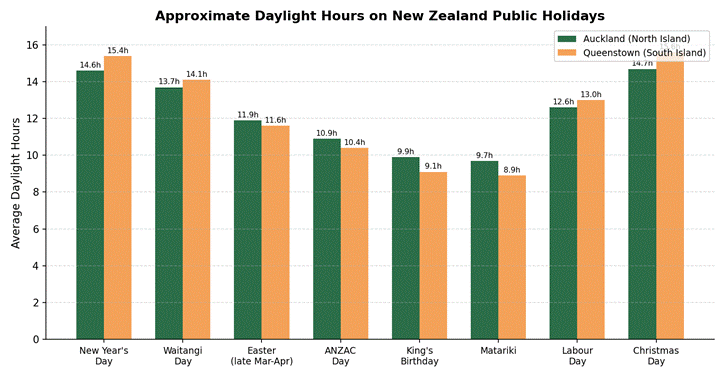
Auckland’s longest day delivers around fourteen hours and forty-four minutes of daylight, while its shortest day drops to roughly nine hours and forty minutes, a swing of about five hours. Queenstown’s longest day stretches out to close to fifteen hours and forty minutes, while its shortest day can fall to around eight hours and forty-nine minutes, a swing of nearly seven hours. In practical terms, that means southern summer evenings feel especially long and golden, while southern winter afternoons close in noticeably earlier than they do further north.
Travellers heading to destinations further south during winter, including Queenstown, Wanaka, and Dunedin, should build shorter driving windows into their itineraries and avoid scheduling long scenic drives for late afternoon.
Daylight Hours Across New Zealand’s Public Holidays
The chart below compares approximate average daylight hours for each public holiday between Auckland and Queenstown, making it easy to see how much daylight shrinks and grows across the year.
Holiday-by-Holiday Daylight Breakdown
New Year’s Day and the Day After
Falling right in the heart of summer, New Year’s Day and the Day After New Year’s Day come with some of the longest daylight hours anywhere on the calendar. Expect the sun up before 6am in most of the country and still hanging around well past 8:30pm in the evening, sometimes closer to 9:30pm in the far south. This is peak beach, barbecue, and late-evening swim season.
Waitangi Day
Waitangi Day, observed every 6 February, still sits comfortably within summer, though the days have started shortening slightly compared to New Year’s. Expect a sunrise somewhere around 6:20am to 6:30am and a sunset in the 8pm to 9pm range depending on where you are in the country, which makes it a great holiday for outdoor commemorations, waterfront events, and evening gatherings.
Good Friday and Easter Monday
Easter is a movable holiday, shifting between late March and late April depending on the year, and it lands right in the middle of autumn’s fastest daylight change. Because the exact date moves, the sunrise and sunset window is wider than for fixed-date holidays: sunrise can land anywhere from around 6:45am to just past 7:15am, and sunset can fall anywhere between roughly 6:50pm and 7:35pm. Checking the specific dates for the year you are travelling is especially worthwhile for Easter.
ANZAC Day
ANZAC Day, observed every 25 April, is one of the only public holidays where the sunrise time is not just a planning detail, it is the whole point of the day. Dawn services across the country begin before first light so that the ceremony concludes as the sun comes up, generally somewhere around 6:55am in the north and closer to 7:10am to 7:20am further south. By this point in autumn, daylight saving has typically just ended, so afternoons close in earlier too, with sunset often before 6pm.
King’s Birthday
Marked on the first Monday in June, King’s Birthday sits deep in winter, and it shows. Sunrise regularly lands after 7:20am in the north and can push past 8am in parts of the south, while sunset arrives as early as 5pm or even a little before in southern regions. This is the holiday where planning shorter days, particularly for skiing, alpine drives, or outdoor commemorations, genuinely pays off.
Matariki
Matariki, New Zealand’s newest national public holiday marking the Māori New Year, is always scheduled on a Friday in either June or July, close to the winter solstice. Because it is timed around the rising of the Matariki star cluster before dawn, sunrise timing has cultural significance well beyond simple planning purposes. Expect sunrise around 7:25am to as late as 8:25am in the deep south, with sunset arriving before 5:30pm almost everywhere in the country.
Labour Day
Labour Day falls on the fourth Monday in October, right after daylight saving has kicked back in, and the extra clock hour makes a real difference. Sunrise sits around 6:30am to 6:50am, while sunset stretches out to somewhere between 7:25pm and nearly 8pm, giving Labour Day weekend some of the best late-afternoon and early-evening daylight of the shoulder seasons.
Christmas Day and Boxing Day land right at the peak of the New Zealand summer, just after the summer solstice, and daylight hours are close to their annual maximum. Sunrise is typically before 6am nationwide, and sunset stretches out to nearly 8:45pm in the north and past 9:30pm in parts of the deep south, giving families long, warm evenings for Christmas dinners outdoors and Boxing Day beach trips.
Planning a Trip Around Daylight Hours
A little daylight awareness goes a long way when you are building a New Zealand holiday itinerary, whether it is a single long weekend or a multi-week road trip. A few practical habits worth building in:
Check sunrise and sunset for your specific travel dates rather than relying purely on seasonal averages, especially around Easter and the daylight saving changeovers in late September and early April.
Book longer scenic drives, hikes, or ferry crossings earlier in the day during winter holidays, since afternoon light disappears faster than most visitors expect.
Take advantage of extended summer evenings around New Year’s Day, Waitangi Day, and Christmas by shifting dinner reservations, walks, and photography later into the evening.
Remember that regions further south, including Queenstown, Wanaka, Dunedin, and Invercargill, see a bigger swing between summer and winter daylight than northern centres such as Auckland or the Bay of Islands.
For dawn events such as ANZAC Day services or Matariki gatherings, arrive at least thirty minutes before the stated sunrise time, since crowds and parking can add unexpected delays.
Planning a Trans-Tasman Trip? Daylight Matters on the Australian Leg Too
A lot of travellers pair a New Zealand holiday with time across the ditch in Australia, and the same daylight logic applies there. If your itinerary includes a coastal detour, it is worth timing it around the light rather than the clock. Anglesea on Victoria’s Great Ocean Road is a good example of a spot where early starts pay off, and the same applies to day trips out to Healesville in the Yarra Valley or the cooler forest towns around Monbulk in the Dandenong Ranges, where light fades faster once you are under tree cover. If waterfalls are on your list, building your Melbourne waterfall day trip around midday light rather than late afternoon will make a genuine difference to photos and track visibility.
A Quick Word on Data Accuracy
New Zealand’s public holidays and their legislated dates are documented in detail on Wikipedia’s overview of public holidays in New Zealand, which is a useful starting point if you want to confirm exactly how a holiday is calculated or Mondayised in a given year. For sunrise and sunset science specific to New Zealand locations, the Royal Astronomical Society of New Zealand publishes reference tables that astronomy-minded readers may find useful for cross-checking regional variations in more technical detail than covered here.
Frequently Asked Questions
What time does the sun rise in New Zealand on public holidays?
It depends entirely on the season. Summer holidays such as New Year’s Day and Christmas Day typically see sunrise before 6am, while winter holidays such as King’s Birthday and Matariki can push sunrise past 7:30am, and even later than 8am in parts of the South Island.
What time does the sun set in New Zealand on public holidays?
Sunset ranges from as early as 5pm on winter holidays like King’s Birthday to as late as 9:30pm on summer holidays like Christmas Day and New Year’s Day, particularly in southern regions such as Queenstown and Dunedin.
Does New Zealand have more daylight in the North Island or South Island?
Neither island has more daylight overall across a full year, but the South Island experiences a bigger swing between its longest and shortest days. Southern regions get noticeably longer summer evenings and noticeably shorter winter afternoons compared with the North Island.
Why does ANZAC Day sunrise timing matter so much?
ANZAC Day dawn services are deliberately scheduled to conclude as the sun rises, so the actual sunrise time on 25 April is central to the ceremony itself rather than just a scheduling detail.
Does daylight saving affect New Zealand’s public holidays?
Yes. Holidays that fall inside daylight saving, such as Waitangi Day and Christmas Day, benefit from an extra clock hour of evening light. Holidays in standard time, such as King’s Birthday and Matariki, do not get that boost, which is part of why they feel darker earlier.
Which New Zealand public holiday has the longest daylight hours?
Christmas Day and New Year’s Day typically have the longest daylight hours nationwide, sitting closest to the December summer solstice, when the sun is up for close to fifteen hours in southern parts of the country.
Which New Zealand public holiday has the shortest daylight hours?
Matariki and King’s Birthday usually have the shortest daylight hours, both falling close to the June winter solstice, when parts of the South Island see under nine hours of daylight.
How much does sunrise and sunset time change between Easter and ANZAC Day?
Quite a lot, because both sit near the end of daylight saving in early April. In the space of a few weeks, sunset can shift by close to an hour as the clocks change and the country moves further from the autumn equinox toward winter.
Related Reading
Continue planning your Australia and New Zealand travel with more guides from the OzKiwiLife team:
Disclaimer: Sunrise and sunset times in this guide are approximate averages intended for general trip-planning purposes only and are not exact for every year or exact address. Always check a live, date-specific sunrise and sunset source before relying on these times for events such as dawn services.