Ask a mate how big Australia is next to America and you’ll usually get a shrug and a guess. Some reckon it’s about the same. Others swear the Yanks win by a mile. The honest answer sits somewhere in the middle, and it depends on which America you’re measuring.
Here’s the quick version. Australia covers about 7.69 million square kilometres. The United States covers about 9.83 million once Alaska and Hawaii are counted, which makes it roughly 28 per cent bigger. Take Alaska and Hawaii out and compare Australia with the lower 48 states, and the gap shrinks to around five per cent. Put simply, Australia is nearly as big as the American mainland, with a fraction of the people living on it.
Australia size compared to USA: The short answer in numbers
Before the maps and the fun comparisons, here’s how the two countries stack up on the basics. Figures are rounded so they’re easy to remember.
| Measure | Australia | United States | What it means |
| Total area | 7.69 million sq km | 9.83 million sq km | The US is about 1.28 times bigger |
| Lower 48 states only | Not applicable | About 8.08 million sq km | Australia is about 95 per cent of this |
| Rank by area | 6th in the world | 3rd or 4th | Depends on how water is counted |
| Population | About 27 million | About 340 million | Roughly 12 Americans for every Aussie |
| People per sq km | About 3.5 | About 35 | The US is about ten times more crowded |
| East to west span | About 4,000 km | About 4,500 km (lower 48) | America is wider |
| North to south span | About 3,700 km | About 2,850 km (lower 48) | Australia is taller |
| Standard time zones | 3 on the mainland | 4 in the lower 48 | Both are a long way across |
Why the two answers? Area figures change depending on what gets counted. The total for the United States includes lakes and coastal water inside its borders. Australia’s official figure of 7,692,024 square kilometres, published in the Australian Bureau of Statistics Year Book, includes the mainland, Tasmania and the offshore islands. Whenever you see two websites arguing over a few hundred thousand square kilometres, this is usually the reason.
Australia against the lower 48 states
The cleanest way to compare the two is to lay them side by side on the same scale. The map below does exactly that, using an equal-area projection so neither country gets stretched.
Australia and the contiguous United States on the same equal-area scale.
Notice the shapes. The American mainland is a wide, flat rectangle, around 4,500 kilometres from coast to coast but only about 2,850 kilometres from top to bottom. Australia is closer to a square. The distance from Cape York in the north to South East Cape in Tasmania is about 3,700 kilometres, and the run from Steep Point in Western Australia to Cape Byron in New South Wales is about 4,000 kilometres. So Australia gives up some width but makes it back in height.
That’s why the two countries feel so similar in size when you drive them. Both have a few thousand kilometres of road between the big cities, and both have a huge dry middle that most people only see from a plane window.
Alaska, Texas and California for scale
Most Americans think of their country in states, so let’s do the same. Alaska is the biggest US state by a long way, and it still only covers a bit over a fifth of Australia. Texas, the state Texans like to call enormous, would fit into Australia about eleven times. California, home to nearly 40 million people, would fit about eighteen times.
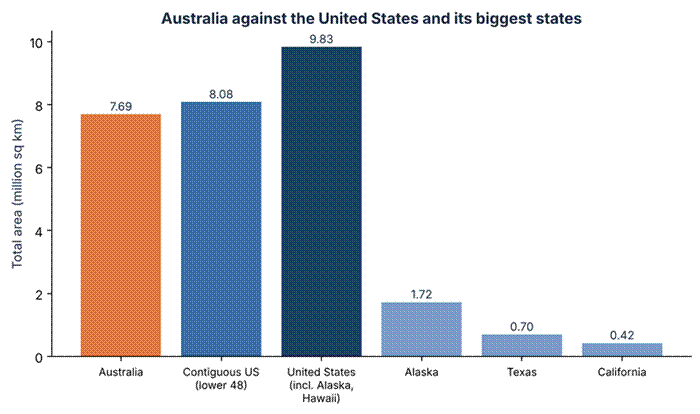
Total area in millions of square kilometres.
State by state: how Australia’s pieces measure up
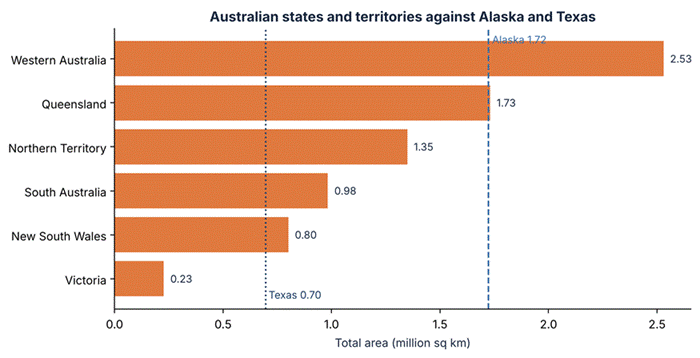
Australia’s own states are big enough to make American comparisons look easy. Queensland, for example, is almost the same size as Alaska. Western Australia is about one and a half times Alaska on its own, which is a bit mind-bending when you remember it’s just one of six states.
| State or territory | Area (sq km) | Closest US comparison |
| Western Australia | 2,529,875 | About 1.5 times Alaska, or roughly 3.6 times Texas |
| Queensland | 1,730,648 | Almost exactly the size of Alaska |
| Northern Territory | 1,349,129 | A little under twice the size of Texas |
| South Australia | 983,482 | About 1.4 times Texas |
| New South Wales | 800,642 | About 15 per cent bigger than Texas |
| Victoria | 227,416 | A bit over half the size of California |
| Tasmania | 68,401 | A touch bigger than West Virginia |
Australian states and territories against Alaska and Texas. Area figures from the ABS Year Book.
Even little old Victoria, the smallest mainland state, is bigger than many countries. It just looks tiny on the map because it sits next to its much larger neighbours.
Sydney to Perth against New York to Los Angeles
You’ll often read that flying from Sydney to Perth is the same as flying from New York to Los Angeles. It’s a handy line, but it’s not quite right. By air, Sydney to Perth is about 3,300 kilometres and takes roughly five hours. New York to Los Angeles is about 3,950 kilometres and takes closer to six. By road, Sydney to Perth is close to 4,000 kilometres, while New York to Los Angeles runs around 4,500.
So the American trip is longer on both counts, but not by a ridiculous amount. If you’re curious how the two ends of that trip sit on the continent, you can check the route on Google Maps, and our plain guide to where Australia is located on the map explains how the capitals and oceans fit around the country.
Where the people are
Size is only half the story. Australia has about 27 million people, which is fewer than live in Texas alone. America has about 340 million. Spread across their land, that works out to around 3.5 people per square kilometre in Australia and about 35 in the United States.
Averages hide the real picture, though. Most Australians live in cities on or near the coast, especially along the south-east. The red centre is huge, dry and very quiet. You can drive for hours past nothing but saltbush, a roadhouse and the odd wedge-tailed eagle.
The upside of all that coastal crowding is a food and coffee scene that punches well above its weight. Sydney alone has enough to keep you busy for weeks, from the cafes locals actually queue for to the kebab shops people cross the city to visit.
Why the size matters if you’re planning a trip or a move
Plenty of visitors underestimate Australia. They see a few cities on a map, plan to tick off Sydney, Uluru and the Great Barrier Reef in a week, and then find out how far apart everything really is. A few practical points help:
- Treat domestic flights like international hops. A Melbourne to Perth flight is around four hours, and prices swing a lot depending on the season.
- Pick two or three regions, not ten. Trying to cover the whole country in one trip means more time in airports than on beaches.
- Remember the time zones. The mainland has three standard time zones, and daylight saving changes things again in some states.
- Allow for long drives. If you hire a car, plan fuel and rest stops well ahead in remote areas, because the gaps between towns can be very large.
If you’re moving here rather than visiting, the same logic applies. Where you land will shape your whole lifestyle. And when it’s time to furnish a new place on a budget, our list of classified ads sites in Australia is a good place to start looking.
Map view and key addresses
If you want to dig into official Australian mapping and area data, these two Canberra addresses are worth knowing. Both are easy to open in a map app.
- Geoscience Australia: Cnr Jerrabomberra Avenue and Hindmarsh Drive, Symonston ACT 2609. The national agency for mapping and geoscience data. Open in Google Maps.
- Parliament House: Parliament Drive, Canberra ACT 2600. Australia’s capital sits roughly between Sydney and Melbourne, so it’s a handy reference point for the south-east. Open in Google Maps.
The bottom line
Australia isn’t bigger than the United States, but it’s closer than most people think. Against the lower 48 states it’s about 95 per cent of the size, and it’s taller from north to south than America is. What really sets the two apart is how few people share all that space. Whether you’re planning a holiday, a move or just settling a pub argument, remember this: the distances here are real, so give yourself more time than the map suggests.
Frequently asked questions
Is Australia bigger than the USA?
No. The United States is about 28 per cent bigger once Alaska and Hawaii are included. The Wikipedia list of countries by area ranks the US third or fourth and Australia sixth.
Is Australia bigger than the lower 48 states?
Slightly smaller. Australia’s 7.69 million square kilometres is about 95 per cent of the roughly 8.08 million square kilometres in the contiguous US. The ABS Year Book even describes Australia as almost as great in area as the United States without Alaska.
How many Texases fit inside Australia?
About eleven. Texas covers roughly 696,000 square kilometres, and Australia covers about 7.69 million. Texas also has more residents than the whole of Australia.
Is Sydney to Perth the same distance as New York to Los Angeles?
Not quite. Sydney to Perth is about 3,300 kilometres by air and close to 4,000 by road, while New York to Los Angeles is about 3,950 by air and around 4,500 by road. Our guide to where Australia sits on the map shows how the main cities line up.
Which Australian state is the biggest?
Western Australia, at about 2.53 million square kilometres. It covers roughly a third of the whole country and is bigger than Alaska.
How does Australia’s population compare with the USA?
Australia has about 27 million people against roughly 340 million in the United States. That’s about one Australian for every twelve Americans, which is why Australian cities feel so much more compact and why the outback is so empty.
How long does it take to drive across Australia?
Sydney to Perth is close to 4,000 kilometres, so most drivers allow at least four or five days with sensible rest stops. If you’re stocking up on the way, a good coffee in a big city is never a bad idea, and the best cafes in Sydney are a decent place to start the trip.
Related posts
- Where Is Australia Located on the Map? A Plain Guide to Its Place in the World
- Best Cafes in Sydney: 18 Spots Locals Actually Queue For
- Best Kebab Shops in Sydney: 10 Spots Locals Keep Going Back To
- Classified Ads Sites in Australia: 27 Places to Buy, Sell, Hire and Rent
- AUS Local Sites: The Numbered List of Australian Directories Worth Your Time
Disclaimer
This article is general information only. Area, distance and population figures are rounded and can differ between sources because of how borders, water and islands are counted. Check official sources such as the Australian Bureau of Statistics and Geoscience Australia for the latest data. Addresses and travel times are provided as a guide, so confirm details before you travel. Links to other sites are provided for convenience, and we aren’t responsible for their content.