A grounded, numbers-first look at buying into one of Australia’s most recognised chicken brands — costs, support, profit potential and what nobody puts in the brochure.
Anyone who has driven along an Australian highway has seen the red rooster sign glowing outside a drive-thru at some point in their life. It is one of those brands that feels like it has always been there, sitting somewhere between a childhood memory and a Friday night dinner shortcut. That familiarity is exactly why so many prospective business owners start looking into a Red Rooster franchise in the first place. Recognition builds trust, and trust is worth real money in the fast food game.
But brand nostalgia does not pay a lease, and it will not cover a fit-out invoice either. Before signing anything, a serious buyer needs the real figures: what the franchise actually costs, what ongoing fees look like, how much support you genuinely get, and whether the numbers stack up against the effort of running a quick-service restaurant six or seven days a week. This guide walks through all of it, written specifically for the Australian market, without the sales gloss that tends to creep into franchisor marketing pages.
A Quick History of Red Rooster
Red Rooster began life in 1972 when brothers Peter and Theo Kailis opened a roast chicken shop in Kelmscott, Western Australia, borrowing ideas from the American fast food boom that had recently reached Australian shores. By 1981 the chain had grown to 45 outlets and was picked up by Myer Emporium, which accelerated expansion. In 2010 the business moved fully into a franchise model, and it now sits under Craveable Brands, the same group that owns Oporto and Chicken Treat, with ownership currently traced back to PAG Asia Capital.
Today the network spans more than 350 restaurants across suburban, regional and rural Australia, the large majority of them independently run by franchisees rather than the corporate head office. You can read a fuller account of the brand’s evolution on its Wikipedia entry, which covers the ownership changes and menu shifts in more detail than most franchise sales pages bother to mention.
Why Investors Keep Looking at Red Rooster
The appeal is not complicated. Red Rooster owns a category — roast chicken — that has far less direct competition than burgers or coffee. It has national brand recognition without the astronomical entry price of a global giant. And because most locations already have an established customer base, a new franchisee is not starting from zero the way an independent café owner would be.
- Strong drive-thru and delivery infrastructure already built and tested
- Decades of brand recognition across metro, regional and rural Australia
- A defensible menu category with fewer direct competitors than burgers or pizza
- Established supply chain, POS systems and staff training frameworks
- Ongoing national marketing that a small independent operator could never fund alone
None of that guarantees profitability at any individual site, and that caveat matters more than most franchise brochures let on. Location, local competition, lease terms and your own operational discipline still decide whether a store makes money or quietly bleeds it.
Red Rooster Franchise Cost in Australia
Investment figures vary depending on whether you are buying an existing store, taking on a resale, or building a brand-new site from the ground up. Based on current franchise listings and disclosure summaries circulating in the Australian market, here is a realistic breakdown.
| Cost Item | Typical Range (AUD) | Notes |
| Franchise fee | $50,000 + GST | Covers brand licence, training and onboarding |
| Total new site investment | $400,000 – $900,000 | Varies with location, size and format |
| Existing/resale store | $370,000 – $1,000,000+ | Depends on turnover and lease term remaining |
| Ongoing royalty | Percentage of gross sales | Confirm exact rate in the Disclosure Document |
| Marketing levy | Percentage of gross sales | Funds national advertising and promotions |
| Franchise term | 10-year agreement (typical) | Renewal terms vary by site |
Table 1: Indicative Red Rooster franchise costs in Australia. Always confirm exact figures in the current Franchise Disclosure Document before committing.
A brand-new, purpose-built drive-thru will sit at the top of that range because of land, construction and equipment costs. A smaller food-court or shopfront format, or a resale of an existing profitable store, can come in noticeably cheaper. The one number that does not move is the $50,000 plus GST franchise fee, which is fairly standard for an established Australian QSR brand of this size.
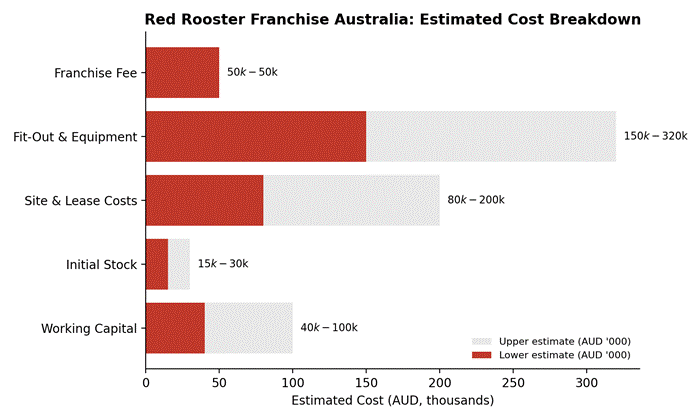
Chart 1: Estimated cost breakdown for a new Red Rooster restaurant in Australia, by category (figures in AUD thousands).
What the Franchise Fee Actually Buys You
Franchisees are not simply paying for the right to hang a sign outside a building. The fee and ongoing royalty structure is meant to cover a package of support that includes:
- Site assessment and lease negotiation guidance
- Store design, fit-out specifications and kitchen equipment sourcing
- An initial training program that typically runs six to ten weeks
- Access to the established supply chain and preferred suppliers
- POS systems, online ordering platform and loyalty program integration
- Ongoing operational support from regional business consultants
- National marketing campaigns funded through the marketing levy
Whether that package feels worth the price depends heavily on your own experience. Someone who has never run hospitality staff rosters, managed food cost percentages or dealt with a commercial lease will get genuine value from the training. Someone with fifteen years in QSR management may feel like they are paying a premium for systems they could largely replicate themselves.
Support, Training and Day-to-Day Operations
New franchisees generally go through an intensive training period before opening, covering food safety, kitchen workflow, rostering, customer service standards and the point-of-sale system. After opening, most Australian QSR franchisors — Red Rooster included — assign a business consultant who visits periodically to review performance, sales trends and compliance with brand standards.
It is worth going in with realistic expectations about staffing. Quick-service restaurants run on casual and part-time labour, and in the current Australian wages environment, labour cost control is one of the biggest levers separating a profitable store from a break-even one. A franchisor’s systems can guide rostering, but they cannot manage the roster for you.
Profit Potential: What Owners Can Realistically Expect
Public franchise sale listings occasionally disclose weekly turnover and profit figures for specific stores, and they vary enormously. Some regional locations report weekly revenue in the mid-thirty-thousand-dollar range with healthy returns once overheads are accounted for; other sites, particularly newer or lower-traffic locations, take years to reach that level. As a rule of thumb across the Australian QSR franchise sector, return on investment tends to sit somewhere between the high single digits and low double digits annually once a store is established, though this is highly site-dependent and should never be taken as a guarantee.
Prospective buyers should always request at least two to three years of financial statements for any existing store being sold, along with the current lease terms, before treating any advertised profit figure as reliable.
Pros and Cons of a Red Rooster Franchise
| Pros | Cons |
| Nationally recognised, trusted Australian brand | High upfront capital requirement ($400k+) |
| Established supply chain and operating systems | Ongoing royalty and marketing levy reduce net margin |
| Structured training reduces the learning curve | Long hours and hands-on management expected |
| Category leadership in roast chicken | Performance heavily tied to site location and lease |
| National marketing support included | Limited control over menu and pricing decisions |
Table 2: A balanced view of the advantages and trade-offs of Red Rooster franchise ownership.
Steps to Apply for a Red Rooster Franchise
- Submit an initial enquiry through the official Red Rooster franchising channel
- Attend an introductory discussion covering your background, finances and goals
- Review the Franchise Disclosure Document with an accountant and a franchise lawyer
- Assess available territories or existing resale stores that match your budget
- Secure finance and finalise the lease or purchase agreement
- Complete pre-opening training before taking over operations
Under the Franchising Code of Conduct, Australian franchisors are legally required to give prospective franchisees a Disclosure Document and a copy of the Code at least fourteen days before signing an agreement or making a non-refundable payment. This cooling-off period exists specifically so buyers have time for independent legal and financial advice — do not skip it, no matter how confident the sales conversation feels. You can read the current rules directly on the Australian Competition and Consumer Commission’s page covering the Franchising Code, or review the general concept of franchising on Wikipedia’s overview of how franchise agreements work.
Location Strategy Matters More Than the Brand
Two Red Rooster stores under the same brand, same menu and same support structure can post wildly different results purely because of where they sit. High-traffic arterial roads, drive-thru accessibility and nearby population density do more to determine turnover than almost any other factor. If you are scouting potential sites in Melbourne, it helps to understand how foot traffic and local food culture actually behave in different pockets of the city — our guides on Melbourne’s best steak restaurants and Collingwood’s cafe scene give a genuine, ground-level read on which suburbs draw consistent food and drink spending rather than relying on generic demographic reports.
The same logic applies to seasonal demand. A drive-thru near a busy summer strip behaves differently to one in a quiet suburban pocket, and our rundown of Melbourne’s best beer gardens is a useful reminder of just how much foot traffic shifts with the weather and the season across Victoria.
If you are weighing up a food-court format versus a stand-alone site, it is also worth studying how dessert and treat-driven venues build repeat customers — our look at Melbourne’s best ice cream and gelato spots shows how consistent quality and a strong local reputation keep queues forming long after the novelty wears off, a lesson that applies just as much to a roast chicken drive-thru as it does to a gelato counter.
Is a Red Rooster Franchise a Good Investment in Australia?
There is no single answer that applies to every buyer. For someone with hospitality management experience, enough capital to absorb a slow first year, and access to a genuinely strong site, a Red Rooster franchise can be a sound, income-generating small business backed by a recognisable national brand. For someone stretching their finances to the limit on a marginal location, the same franchise can just as easily become a stressful, low-margin grind.
The honest advice that applies to any Australian franchise purchase, not just this one, is to treat the brand name as the smallest part of the decision. Spend more time on the lease terms, the site traffic data, the real financial history of the specific store, and your own appetite for the long hours that quick-service restaurants demand. The rooster on the sign will not run the business for you.
Frequently Asked Questions
How much does a Red Rooster franchise cost in Australia?
Total investment typically ranges from roughly $400,000 to $900,000 for a new site, with a separate franchise fee of $50,000 plus GST. Resale of an existing store can fall outside that range depending on turnover and remaining lease term.
Does Red Rooster provide training for new franchisees?
Yes. New franchisees generally complete an intensive pre-opening training program, often six to ten weeks, covering food safety, kitchen operations, rostering and the point-of-sale system, followed by ongoing support from a business consultant after opening.
Do I need hospitality experience to buy a Red Rooster franchise?
Prior hospitality experience is not always a strict requirement, but strong business management skills, financial discipline and a willingness to work long, hands-on hours are considered essential by most franchisors in this sector.
How long is a Red Rooster franchise agreement?
Franchise agreements are commonly structured around a ten-year term, though exact conditions and renewal options should always be confirmed in the current Franchise Disclosure Document for the specific site you are considering.
What ongoing fees does a Red Rooster franchisee pay?
Beyond the upfront franchise fee, franchisees typically pay an ongoing royalty and a marketing levy, both usually calculated as a percentage of gross sales. Exact percentages vary and are set out in the Disclosure Document.
Is buying an existing Red Rooster store better than building a new one?
An existing profitable store can mean faster cash flow and a known trading history, but often at a higher purchase price. A new build gives more control over location and format but carries the risk and cost of building a customer base from scratch. Both paths require careful due diligence on the numbers.
Related Posts
- Best Steak Restaurants in Melbourne: A Local’s Honest Guide
- Best Coffee in Collingwood: A Local’s Honest Cafe-by-Cafe Guide
- Best Beer Gardens Melbourne: A Local’s Honest Suburb-by-Suburb Guide
- Best Ice Cream and Gelato in Melbourne: A Local’s Scoop-by-Scoop Guide
Explore more Australian food, lifestyle and city guides at OZ Kiwi Life.
Disclaimer: This article is general information only and does not constitute financial, legal or investment advice. Figures are indicative and drawn from publicly available franchise listings; always confirm current costs, fees and terms directly with the franchisor’s official Disclosure Document and independent professional advisers before making any investment decision.