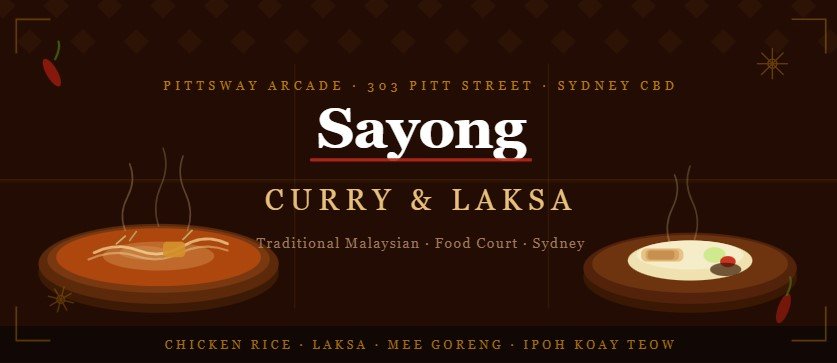
Down a Pitt Street arcade, past the office workers and the mobile phone repair kiosk, there is a stall that has been quietly feeding half the CBD better Malaysian food than most restaurants charge sixty dollars for.
The first thing you notice is the sound. Even before you smell anything, you can hear Sayong Curry and Laksa from the corridor — not loud music, not a television, just the controlled clatter of a kitchen running hard and two blokes calling orders back and forth across a narrow counter. One takes the money. One runs the food. The system is so tight you could set a stopwatch to it.
I have been going to Sayong on and off for longer than I care to admit. It started as a semi-accidental discovery — took a wrong turn through Pittsway Arcade trying to cut through to Market Street, followed my nose, ended up with a bowl of laksa that made me late back to the office, and frankly did not care at all. Since then it has become one of those places I find myself pointing people towards whenever someone complains that good food in the Sydney CBD is too expensive, too pretentious, or too hard to find.
None of those things apply here.
| Sayong is the kind of place where you tell someone about it and they say they have walked past it a hundred times without going in. Then they go in. Then they tell someone else. |
At a Glance: Sayong Curry and Laksa
| Address | Pittsway Arcade, 303 Pitt Street, Sydney NSW 2000 |
| Phone | +61 2 9261 3623 |
| Cuisine | Malaysian — Traditional |
| Price Range | $ — most dishes $8.50 to $12 |
| Reservations | Not accepted — walk-in only |
| Nearest Train | Town Hall Station (~3 min walk) |
| Setting | Food court, counter service, shared tables |
Opening Hours of Sayong Curry and Laksa
| Monday | 10:00 am – 4:00 pm |
| Tuesday | 10:00 am – 4:00 pm |
| Wednesday | 10:00 am – 4:00 pm |
| Thursday | 10:00 am – 4:00 pm |
| Friday | 10:00 am – 4:00 pm |
| Saturday | 10:00 am – 3:00 pm |
| Sunday | Closed |
The opening hours are a hard boundary, not a guideline. Sayong is open Monday through Friday from ten in the morning until four in the afternoon, and on Saturdays from ten until three. Sundays are closed. If you are planning a visit, do not assume flexibility on either end of those times — the kitchen winds down and the staff have put in a full day by the time closing rolls around.
Saturday is consistently less frantic than any weekday. The surrounding office buildings are mostly empty, the lunchtime urgency is gone, and you can actually sit and eat without that slightly pressured feeling of six other people needing your table. Worth knowing if you are in the city for shopping or errands and want a quieter experience.
The Setup — What Kind of Place Is This, Exactly
Food court, technically. But that framing does the place a disservice in the same way that calling the MCG ‘a sports field’ is technically accurate but misses something important.
The Pittsway Arcade runs through the building at 303 Pitt Street, one of those old-school Sydney CBD arcades where the natural light never quite reaches. The food court is downstairs, slightly cave-like, and populated at lunchtime by accountants, tradies who have knocked off early, the odd tourist who looked confused and then looked relieved, and a hard core of regulars who sit in the same spot every time. Sayong occupies a stall towards the interior. The menu is on the board above the counter. The curries of the day sit in a bain-marie. The cooked-to-order dishes are listed, and they are what you are really here for.
There are no reservations. No one is going to walk you to a table. You join the queue — and there will be a queue between roughly noon and one-thirty — you tell the counter guy what you want, you answer the chilli question (always say yes), you pay, and you find somewhere to sit. That is the whole ceremony.
What you get in return is Malaysian food cooked by people who know what they are doing and appear to genuinely enjoy doing it. In a CBD full of tired meal-deal sandwiches and overpriced grain bowls, that is worth something.
What to Order: The Honest Version
I have eaten my way through most of the menu over many visits. Here is what I actually think, in the order I would recommend things to someone who has never been before.
Start here: the chicken rice
Hainanese chicken rice is one of those dishes that sounds simple until you eat a bad version of it, at which point you realise how many things can go wrong. The chicken can be overcooked and rubbery. The rice can be steamed in plain water and taste accordingly. The chilli sauce can be that thin red stuff from a bottle with a rooster on it. The soup on the side can taste of nothing at all.
At Sayong, none of that happens. The chicken is poached gently, still yielding at the joint, the skin intact and slightly gelatinous in the way that tells you it was handled carefully. The rice is cooked in stock — you can smell it from across the counter — with pandan and ginger, and it has a fragrance and slight richness that plain steamed rice simply does not have. The chilli and ginger sauces are made in-house. The soup is clean and savoury and worth drinking.
Order the leg. Breast is fine. Leg is better. Regulars who have been coming here for years place this order using a single word. The counter guy nods. He has heard it three hundred times this week and he is still smiling when he hears it again.
The laksa
This is what Sayong has in the name, and it earns its place there. The broth is a curry laksa — coconut-based, deep-coloured, built on a paste that has clearly not come from a supermarket jar. There is lemongrass in there, and galangal, and dried shrimp, and enough complexity that you find yourself tasting different things as the bowl cools slightly. Rice vermicelli at the bottom, chicken and tofu puffs on top, bean sprouts for texture, a swirl of coconut cream.
The tofu puffs are the detail that separates this from lesser versions. They have been allowed to soak up the broth properly, so when you bite into one you get a small burst of curry rather than a mouthful of plain soy protein. That is not an accident. Someone knows what they are doing.
Ipoh koay teow soup
This one surprises people who go in expecting another curry hit. The Ipoh koay teow soup is quiet, almost delicate. Flat rice noodles in a clear broth that has been built from chicken bones and dried seafood — the broth is not showy but it is very well made, with a depth that keeps you spooning it long after the noodles are gone. Sliced chicken, prawns, and a handful of bean sprouts. No chilli hit, no coconut richness, just a well-constructed bowl of something clean and properly flavoured.
Mee goreng
The fried noodle dish. Yellow wheat noodles in the wok with egg, potato, tomato, and tofu — the Malaysian mamak version rather than anything approximating what you get from a packet. There is a sweetness to the sauce, a heat from the chilli, and — if the timing is right — a bit of wok breath on the noodles that you cannot replicate on a domestic stove. Filling, satisfying, and quite a different experience from the soup dishes.
Ipoh fried koay teow
Similar to mee goreng in format but completely different in character. The flat rice noodles pick up more colour from the wok, more char, more caramelisation from the dark soy. Bean sprouts, egg, your choice of protein. If mee goreng is warm and sweet, fried koay teow is smokier and more direct. Both are worth ordering at least once.
Ipoh bean sprout chicken with noodle soup
This one is for people who are sceptical about bean sprouts, which includes me at most restaurants and does not include me here. Ipoh bean sprouts are a different product from the pale, thin things you find bagged in the supermarket. They are thick-stemmed, crunchy, and have an actual flavour of their own. The dish combines poached chicken with a pile of these sprouts and a noodle soup on the side. Filling without being heavy, which is a useful trick for a lunchtime dish.
The bain-marie curries
Worth trying and consistently overlooked by people who go straight to the cooked-to-order menu. These are the dishes the staff eat for their own lunch, which is a more reliable recommendation than anything I could offer. Rotating daily selection — usually a chicken or beef curry, sometimes a rendang. Ask what is in the bain-marie when you get to the counter.
What It Costs — A Proper Price Breakdown
One of the most refreshing things about eating at Sayong is that the maths works out easily. You are not mentally calculating whether you can afford to add a side dish. The prices below are approximate — always confirm at the counter.
| Dish | What You Get | Price |
| Hainanese Chicken Rice ★ | Poached chicken, stock-cooked rice, soup, chilli, ginger sauce | ~$8.50 |
| Chicken Laksa ★ | Coconut curry broth, rice vermicelli, chicken, tofu puffs, bean sprouts | ~$10–$11 |
| Mee Goreng | Fried yellow noodles, egg, tofu, tomato, potato, sambal | ~$8.50–$10 |
| Ipoh Koay Teow Soup | Flat rice noodles, clear Ipoh broth, chicken, prawns, bean sprouts | ~$9–$10 |
| Ipoh Fried Koay Teow | Wok-fried flat rice noodles, dark soy, egg, bean sprouts | ~$9–$10 |
| Ipoh Bean Sprout Chicken | Poached chicken, Ipoh bean sprouts, noodle soup on the side | ~$9 |
| Bain-marie Curry + Rice | Daily rotating Malaysian curries — ask at counter | ~$8.50–$12 |
| Drinks | Canned drinks, bottled water | ~$2–$4 |
★ Most recommended for first-time visitors.
For context: a full meal with a drink at Sayong will land somewhere between ten and fifteen dollars in almost every scenario. In a postcode where a modest sandwich and a coffee can set you back eighteen dollars without anyone blinking, this is genuinely unusual.
Getting There Without Getting Lost
The address is Pittsway Arcade, 303 Pitt Street, Sydney NSW 2000. If you have never been into this particular arcade, you might walk past the entrance a couple of times before spotting it — it is a pedestrian throughway cut into the building, set slightly back from the street. Head downstairs when you are inside.
Town Hall station is the obvious choice by train — exit towards Park Street and Pitt Street and you will be there in three minutes. St James station is slightly further, maybe five minutes depending on which exit you use. If you are coming from Wynyard, it is a pleasant ten-minute walk down past the Strand Arcade.
Driving into the CBD for this specific lunch is optimistic. Parking in that stretch of Pitt Street is limited, expensive, and time-restricted. Public transport is considerably less stressful.
Tips for First-Time Visitors
- Arrive before noon to get freshly cooked dishes and avoid the main queue.
- For chicken rice, always ask for leg or thigh — it is juicier and more flavourful than breast.
- Say yes to the chilli. You can always ask for it on the side if you want to control the heat.
- Ask what is in the bain-marie — the staff eat it themselves, which tells you a lot.
- Saturday is quieter than any weekday and a good time to visit at your own pace.
- If someone who ordered after you gets served first, that is normal — different dishes take different times.
- Cash tends to be faster during a busy service, though card is usually accepted.
A Quick Note on What Ipoh-Style Actually Means
Several things on the Sayong menu carry the Ipoh label, and it is worth knowing what that refers to because it is not just branding. Ipoh is a city in Malaysia’s Perak state, and it has a food reputation that outpunches its size considerably.
The Ipoh distinction comes down to a few things. The local bean sprouts — grown in spring water, naturally mineral-rich — are thicker, crunchier, and more flavourful than the standard variety. The koay teow (flat rice noodles) from that region are known for being particularly silky. And the Ipoh approach to chicken involves poaching it gently in a clear stock rather than building a heavy sauce around it — a technique that sounds restrained but produces chicken of exceptional tenderness.
You do not need to know any of this to enjoy the food. But it explains why dishes labelled Ipoh at Sayong have a particular character — lighter, cleaner, focused on ingredient quality rather than sauce complexity. It is a genuinely different approach from the laksa tradition, and both are worth experiencing on their own terms.
Read Also: Best Filipino Desserts in AustraliaFrequently Asked Questions of Sayong Curry and Laksa
Q: What is the most popular dish at Sayong Curry and Laksa?
The Hainanese chicken rice is the dish that keeps people coming back. It is also one of the fastest to come out during a busy service, which is part of why you see so many people ordering it. The laksa runs a close second. If you can only try one thing on a first visit, go the chicken rice and specify leg or thigh rather than breast.
Q: How much does a meal at Sayong cost?
Most cooked-to-order dishes are in the eight to twelve dollar range. A full meal with a drink will typically come to between ten and fifteen dollars. By Sydney CBD standards, this represents genuine value — you are getting properly made food at a price that has become increasingly rare in the city.
Q: Do I need to book a table at Sayong?
Sayong does not take reservations and does not operate a booking system. It is entirely walk-in. Join the queue at the counter, order, pay, and find a seat in the food court. During the weekday lunch rush — roughly noon to one-thirty — there will be a wait of a few minutes but the queue moves quickly.
Q: Is Sayong open on weekends?
Yes, on Saturdays from 10:00 am to 3:00 pm. Sundays are closed. The Saturday service is noticeably quieter than weekdays and a genuinely good time to visit if you find the midweek lunch rush too hectic.
Q: Is the food spicy?
The base heat level on most dishes is moderate — enough to have warmth and flavour without being overwhelming. The counter staff will ask whether you want chilli when you order. You can ask for extra, or ask for it on the side. If you genuinely cannot handle any chilli, let them know and the kitchen will adjust where possible.
Q: Where exactly is Pittsway Arcade?
Pittsway Arcade is at 303 Pitt Street in the Sydney CBD. It is a pedestrian arcade that cuts through the building — you enter from Pitt Street and the food court is downstairs. The closest train station is Town Hall, which is about three minutes on foot.
Q: What does Ipoh-style mean on the menu?
Ipoh is a city in Malaysia’s Perak region, known for lighter broths, silky flat rice noodles, and high-quality bean sprouts grown in the region’s spring water. Dishes labelled Ipoh at Sayong draw from this tradition — expect cleaner, more delicate flavours compared to the richer coconut-based laksa.
Q: Why did someone who ordered after me get served first?
Different dishes take different amounts of time to prepare. The kitchen manages order flow based on what it can get out fastest, not strictly by queue order. Chicken rice and laksa tend to come out quickly. Dishes that require more preparation may take a few minutes longer. This is normal kitchen management rather than an error.
Q: Is Sayong suitable for vegetarians?
Some dishes can be adapted, but much of the menu uses chicken stock as a base, including some dishes that might appear vegetarian at first glance. If you have strict dietary requirements, ask the staff directly at the counter — they are generally straightforward about what is and is not possible.
Q: Is there parking near Sayong?
There is street parking on some surrounding streets but it is limited, time-restricted, and competitive during business hours. Several commercial car parks operate within a few minutes walk. Taking the train to Town Hall station and walking three minutes is a far less stressful option.
| THE VERDICT Sayong Curry and Laksa is not the flashiest Malaysian food you will find in Sydney. It is not trying to be. What it is — consistently, over many visits across different days and different dishes — is genuinely good food cooked by people who know what they are doing, served at a price point that feels almost transgressive by Sydney standards. The chicken rice is properly made, which in this city is not as common as it should be. The laksa broth has real depth behind it. The Ipoh dishes are faithful to the tradition they draw from. And the whole operation runs with a cheerful efficiency that suggests the people running it actually like what they do — which, after enough years eating around this city, is something you notice and appreciate. If you work near Pitt Street and you have not been in yet, fix that this week. If you are visiting the CBD for any reason during opening hours, it is worth building in an extra thirty minutes to eat here. And if someone asks you where to find a good, honest, reasonably priced Malaysian lunch in the Sydney city centre, send them to Sayong. They will not regret it, and they will probably forget to thank you because they will be too busy eating. |