There is a place in southern Sydney where the city completely disappears. No traffic noise bleeds through the canopy, no glass towers loom over the ridgeline, and the only sounds you register are the call of a black cockatoo cutting through salt-tinged air and the lap of tidal water against ancient sandstone. That place is Oatley Park — 45 hectares of untamed Sydney bushland stitched to the promontory where the Georges River, Lime Kiln Bay, and Jewfish Bay meet.
Most Sydneysiders have driven past the suburb of Oatley without stopping. That is a mistake worth correcting. Tucked inside this quiet enclave of the Georges River LGA sits one of the south’s most layered green spaces — a place where a retired couple can walk the foreshore trail in the morning, toddlers can rule a multi-storey adventure playground by midday, teenagers can flyox across a grassy clearing in the afternoon, and everyone can finish the day with a swim in the park’s historic netted baths as the river glows amber at dusk.
This guide covers everything you need to know before you visit — the walking tracks, the swimming spots, the wildlife, the history, the picnic areas, the facilities, the access, and all the little details the signage never quite tells you. Whether you live in the Georges River area, you are planning a day out from the CBD, or you are visiting Sydney with children and want to skip the tourist crowds, Oatley Park deserves a full day on your itinerary.
Oatley Park At a Glance
Detail
Information
Address
1 Dame Mary Gilmore Road, Oatley NSW 2223
Size
45 hectares (112 acres) of bushland reserve
Location
Promontory on the Georges River, bounded by Lime Kiln Bay and Jewfish Bay
Oatley village strip (Frederick Street), approx. 1.5 km
A Reserve With Deep Roots: The History of Oatley Park
Long before the first surveyor pegged out a reserve boundary, the headland now known as Oatley Park had been shaped by tens of thousands of years of human occupation. The Bidjigal people of the Eora Nation lived, fished, and hunted across this stretch of the Georges River corridor for generations beyond counting. Middens — layered deposits of shells, bones, and charcoal — tell a quiet story of sustained life along these shores. Sandstone rock overhangs in the park’s bush interior provided shelter during coastal storms and still bear the patina of use. When you walk the headland track today, you are walking country that carries an ancient memory.
European settlement brought rapid transformation. The reserve was gazetted under the name Peakhurst Park in 1888, making it one of the earlier formal reserves in the greater Sydney region. In 1908, the newly formed Hurstville Council was appointed trustee, and the reserve began to take on the recreational character it holds today. It was renamed Oatley Park in 1922, taking its name from the suburb — which itself honours James Oatley, a clockmaker who was transported to the colony in 1814 and later received a land grant on the river’s northern bank.
The years between the two World Wars saw the park’s most characterful additions. The Oatley Baths were constructed in 1909, offering the local community a netted swimming enclosure on the river — a luxury at the time and, in many ways, still a luxury today. Then, between 1929 and 1932, local craftsmen quarried sandstone from within the reserve and built what is now known as Oatley Castle. Constructed during the Great Depression, the castle was originally designed as a kiosk to serve refreshments to park visitors. Its thick walls, arched windows, and battlements overlooking Jewfish Bay gave it the romantic silhouette that has made it a visual anchor of the park for nearly a century. Today the Castle operates as a hireable event space — weddings and milestone birthdays are regularly celebrated in its shadow — but it remains open to all visitors for exploration and picnicking.
Throughout the postwar decades, the park was incrementally improved with roads, parking areas, and basic facilities. More recently, Georges River Council, working alongside the NSW Government’s Open Space and Parklands Program, delivered the park’s most significant modern investment: the Inclusive Adventure Playground completed and opened in September 2019. This project, designed in consultation with the local community and built following the Everyone Can Play guidelines, transformed the playground precinct at Steamroller Park into one of the most celebrated family destinations in southern Sydney.
Management of Oatley Park passed to Georges River Council, formed in 2016 when Hurstville and Kogarah councils amalgamated. Under current management, the park sits within the broader Discover Georges River visitor offering and is linked to a network of regional walking trails along the waterway.
The Lay of the Land: Understanding Oatley Park’s Geography
Oatley Park occupies a sandstone headland — a finger of elevated bushland that juts northward into the tidal waters of the Georges River. The park is bounded on three sides by water: the main channel of the Georges River runs to the north and west, Lime Kiln Bay forms the eastern boundary, and Jewfish Bay curves around the park’s southern foreshore.
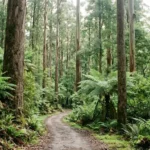
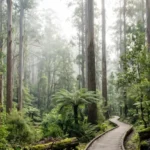
This peninsular geography creates a remarkably diverse set of micro-environments within a relatively compact area. The elevated central ridge supports dry sclerophyll forest dominated by Sydney red gum and angophora, with a dense understorey of flannel flowers, gymea lilies, and banksias. As the land drops toward the river’s edge, the vegetation transitions to moist gully communities sheltering tree ferns, cabbage tree palms, and ground orchids. At the water’s edge, small sandy beaches emerge at low tide, framed by mangroves and saltmarsh communities that provide critical habitat for migratory shorebirds.
The park’s internal road is a one-way loop — an important detail for first-time visitors driving in. The loop road is shared with cyclists and pedestrians and carries a maximum speed of 20 kilometres per hour. It connects the main parking areas near the entrance on Dame Mary Gilmore Road with Steamroller Park, the Oatley Baths, Jewfish Bay, and the Castle. Visitors can also park at several informal spots along the loop.
Walking Tracks and Bush Trails at Oatley Park
Walking is the primary reason many people visit Oatley Park, and the trail network rewards those who leave the road behind and push into the bush. The tracks range from wheelchair-friendly sealed paths around Steamroller Park to rougher bush footpads along the Georges River foreshore, where angophora trees lean out over the sandstone shelves and the river is close enough to hear.
The Headland Track
The Headland Track is the most popular walking route in the park, and for good reason. The trail follows the river foreshore around the park’s outer edge, passing through dry sclerophyll bushland with periodic clearings that open up to views across the Georges River toward Kogarah Bay and, on clear days, out to the distant headlands of Botany Bay. The track is mostly level with occasional rocky sections and a few timber-and-steel staircases where the terrain steps down to foreshore level. Allow roughly 45 minutes to walk the full loop at a relaxed pace; more if you are stopping to photograph birds or watching the tide pools.
The track is busy on weekends, particularly in the mid-morning. On weekday mornings, especially outside school holidays, you can walk long stretches in near-solitude. The track is not sealed, so closed-toe shoes or trail runners are strongly recommended. After significant rainfall, sections near the foreshore can become muddy and slippery.
The Lime Kiln Bay Loop
For those wanting a longer outing, the Lime Kiln Bay Loop extends the Oatley Park walk into the adjacent wetlands reserve east of the park boundary. This extended loop connects Lime Kiln Bay’s mangrove-fringed tidal flats with the headland track and the Jewfish Bay foreshore, creating a varied circuit of approximately 6 kilometres that takes between two and three hours at an easy to moderate pace. The route passes through Yawolloh Reserve, crosses the Lime Kiln Bay bridge, and includes a section of shared road walking before rejoining the park’s bush tracks. This extended circuit is one of southern Sydney’s most underrated day walks.
Frog Hollow Track
Frog Hollow is a sheltered gully on the park’s eastern margin where the combination of permanent moisture, dense canopy, and limited human disturbance creates ideal conditions for owls. Powerful Owls have been recorded roosting in this gully, and locals who walk the track at dawn sometimes spot these impressive birds perched in the upper branches of large eucalypts. The track into Frog Hollow is rougher than the main headland route and requires some care with footing, but the rewards — birdsong, tree ferns, relative cool even in summer — are worth the effort.
The Cycling Loop
The one-way internal road doubles as a cycling circuit of approximately 2 kilometres. Because the road is shared with vehicles (at a maximum of 20 km/h), it is most suitable for younger or less confident cyclists who are not yet ready for open roads. The gentle terrain of the loop — with only modest elevation changes — makes it appropriate for small children on balance bikes and older kids building confidence on geared bikes. The loop can be ridden multiple times and connects all of the park’s major attractions.
Walk
Distance
Duration
Difficulty
Highlights
Headland Track Loop
~3 km
45–60 min
Easy–Moderate
River views, angophora forest, foreshore sandstone
Lime Kiln Bay Extended Loop
~6 km
2–3 hours
Easy–Moderate
Wetlands, mangroves, birdwatching, varied terrain
Frog Hollow Track
~1.5 km return
30–45 min
Moderate
Powerful Owls, tree ferns, gully rainforest
Cycling Road Loop
~2 km
15–25 min
Easy
Suitable for families, connects all park zones
Steamroller Park Accessible Path
<1 km
15–20 min
Easy / Accessible
Playground, BBQs, open lawn, river views
Swimming at Oatley Park: The Jewfish Bay Baths
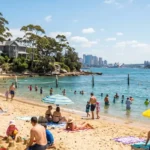
The Jewfish Bay Baths — frequently referred to locally as the Oatley Baths — are one of the park’s most enduring drawcards and, for regular visitors, one of the most beloved swimming spots in the Georges River area. First constructed in 1909, the baths consist of a shark net enclosure on the river’s edge that creates a protected swimming area of genuine size. The main net stretches 320 metres, and a 50-metre section is reserved for the Oatley Swimming Club, which has trained here for generations.
Swimming in the Georges River has a particular quality that ocean pools and indoor aquatic centres cannot replicate. The water is tidal, meaning it moves. It is also considerably warmer than ocean water through the summer months, drawn inland by the narrow waterway and heated by the surrounding bushland. Visibility is not always perfect — this is a working tidal estuary, not a tropical lagoon — but the experience of swimming in a netted enclosure surrounded by angophora-covered headlands, with kingfishers darting along the water’s edge, is genuinely hard to match anywhere in greater Sydney.
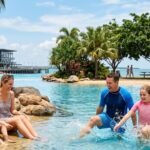
Adjacent to the baths, a shallow sandy bay at Jewfish Bay functions as a natural beach for younger children. The water here is exceptionally calm and shallow, making it ideal for toddlers who are not yet confident in deeper water. Parents can keep watch from the grassed bank directly above. The combination of the sandy bay for young children and the full baths for stronger swimmers means Oatley Park can cater to the full spectrum of swimming ability within a family group.
Access to the baths is free. Toilets are available nearby. There is no lifeguard on duty, so swimming here is at your own risk — standard practice for tidal river baths throughout New South Wales. Water quality is generally good outside of periods of significant rainfall, after which urban runoff can temporarily affect conditions. Check Georges River Council’s website for current water quality notices.
The Inclusive Adventure Playground at Steamroller Park
Before the adventure playground arrived at Steamroller Park, Oatley Park was a wonderful destination for adults, bushwalkers, and swimmers. After the playground opened, it became one of the most talked-about family destinations in Sydney’s south. That is not hyperbole — the Oatley Park Adventure Playground genuinely raises the bar for what a community park playground can be.
The playground was jointly funded by Georges River Council and the NSW Government’s Open Space and Parklands Program and was designed following the Everyone Can Play guidelines — a framework that prioritises inclusive design so children of all physical and developmental abilities can participate. The result is that over 80 per cent of the playground’s footprint is fully accessible, meaning children who use wheelchairs, walking frames, or other mobility aids can reach, interact with, and enjoy the vast majority of what the space offers. This is meaningfully different from playgrounds that add one token accessible swing and call the job done.
The Main Climbing Structure
The centrepiece of the playground is a 12-metre multi-storey tower structure featuring multiple climbing routes, a long tunnel slide, net bridges, rope ladders, and various challenge elements that escalate in difficulty as children ascend. The structure is built predominantly from timber and natural-toned materials that reference the surrounding bushland rather than clash with it — a thoughtful design decision that makes the playground feel like it belongs in the park rather than having been dropped into it from a catalogue.
The Flying Fox
The flying fox (zip line) runs across a generous stretch of open ground and is consistently the element that draws the longest queues on busy weekend mornings. The accessible design means it can be used by children with mobility challenges as well as able-bodied users. Expect to wait if you visit on a Saturday morning during school holidays — this is genuinely one of the park’s most popular features.
Toddler Play Zone
A dedicated toddler area with smaller-scale equipment, soft fall surfacing, and age-appropriate sensory elements sits adjacent to the main structure but is clearly separated enough that parents can keep small children safe without needing to physically block access to the larger equipment above. Spring riders, low climbing elements, and a sandpit-style zone give children from roughly 18 months to four years a space that is genuinely calibrated for their developmental stage.
Swing Bay and Balancing Area
The swing bay includes inclusive basket swings — wide enough for a child who needs support — as well as standard swing seats. Balance beams, stepping logs, and a series of ground-level balancing elements extend the play zone into a broader area of graduated challenge for children aged four to ten.
Teen Breakout Zone
Rather than assuming that teenagers either disappear from parks or monopolise the swings, the playground includes a dedicated teen zone with table tennis, fitness-oriented equipment, and larger-scale balancing structures. It is not flashy, but its presence acknowledges that secondary-school-aged children have different needs from six-year-olds and that parks should serve the whole community.
The playground is surrounded by generous lawned areas, picnic tables, and electric barbecues — making it perfectly suited to the long-lunch model of visiting: let the kids play until they collapse, then feed everyone while they recover before another hour on the flying fox. Shade is provided by a combination of mature trees and sails over parts of the playground, though arriving in the cooler morning hours on hot days is still recommended.
Wildlife at Oatley Park: What to Look For and Where
The ecological richness of Oatley Park is one of its most genuinely underappreciated qualities. The park’s 45 hectares support over 310 native plant species and 107 bird species — figures that reflect both the quality of the bushland and the tidal ecosystems bordering it. For visitors with any interest in Australian native wildlife, Oatley Park offers encounters that require no binoculars, no early-morning alarm, and no specialised knowledge to appreciate.
Birds
Birdwatchers consistently rate Oatley Park as one of the better accessible birding spots in the greater Sydney area. The diversity of habitats — dry sclerophyll forest, gully moisture zone, mangroves, open water, and grassland oval — creates multiple distinct bird communities within a single visit.
Along the headland track, yellow-faced honeyeaters, red wattlebirds, and eastern spinebills feed in the banksias and grevilleas throughout the morning. Kookaburras are reliable at dawn and dusk, often perched on park signage or low branches at the playground edge. Eastern rosellas and crimson rosellas move through the canopy in small groups, easy to find by their colour. On the oval, Australian magpies and Australian white ibis forage in the grass, and during spring the melodic warbling of grey butcherbirds fills the entire park.
The Lime Kiln Bay wetland boundary is the place to head for waterbirds. Pacific black ducks, dusky moorhens, Eurasian coots, and reed warblers are year-round residents of the mangrove-edged tidal flats. Little pied cormorants and great cormorants fish the main river channel and frequently spread their wings to dry on exposed branches near the baths. Royal spoonbills and white-faced herons work the shallows at low tide. On the Georges River itself, Australian pelicans are a near-daily sight.
For experienced birders, Frog Hollow is the main destination. The combination of dense canopy and permanent moisture here attracts less common species including Powerful Owls (recorded regularly), Lewin’s honeyeaters, and — during spring — various migratory species passing through the Sydney Basin. Dawn visits to Frog Hollow in September and October offer some of the most rewarding birding in the Georges River corridor.
Black-cockatoos — both yellow-tailed and glossy — visit the park periodically, usually in small groups working through the banksias and she-oaks on the ridge. Their raucous calls announce their arrival well before you spot them. Seeing a group of yellow-tailed black-cockatoos feeding overhead in Oatley Park’s angophora canopy is one of those moments that reminds you why Sydney’s suburban bushland is worth protecting.
Mammals
Common ringtail and common brushtail possums are abundant in the park’s tree canopy and are most often seen at dusk moving through branches near the parking areas and picnic zones. Echidnas are spotted occasionally in the park’s quieter bush sections — more often in winter when they are actively foraging. Grey-headed flying foxes roost in the mangroves around Lime Kiln Bay and emerge in large numbers at dusk, creating a dramatic overhead spectacle against the evening sky.
Reptiles
Blue-tongue lizards are the park’s most commonly encountered reptile and are often seen basking on warm sandstone outcrops along the headland track. Eastern water dragons are reliably present near the baths and any water source within the park. Common skinks — particularly the garden skink and three-lined skink — dart through leaf litter along the trail edges. Diamond pythons have been recorded in the park and, while rarely seen, should remind visitors to watch where they step in warmer months. None of the commonly encountered reptiles in Oatley Park are dangerous if left undisturbed.
Species
Where to Find It
Best Time
Powerful Owl
Frog Hollow gully
Dawn, year-round (especially winter)
Yellow-tailed Black-Cockatoo
Ridgeline banksias and she-oaks
Morning, irregular
Royal Spoonbill
Lime Kiln Bay / Jewfish Bay tidal flats
Low tide, morning
Eastern Water Dragon
Near Oatley Baths and park waterways
Sunny days, all year
Grey-headed Flying Fox
Lime Kiln Bay mangrove roost
Dusk, warm months
Echidna
Quiet bush sections, away from crowds
Winter mornings
Blue-tongue Lizard
Headland track sandstone outcrops
Sunny morning
Common Ringtail Possum
Tree canopy near parking and picnic areas
Dusk and dawn
Australian Pelican
Georges River main channel
All day, year-round
Dusky Moorhen
Lime Kiln Bay wetlands
All day, year-round
Oatley Castle: A Depression-Era Icon With Views Over the River
Standing on the grassy promontory above Jewfish Bay, the sandstone structure known as Oatley Castle draws visitors’ eyes the moment they round the bend in the park loop road. It is not a real castle in the medieval sense, of course — but in terms of local architectural charm and historical significance, it earns the name.
Construction began in 1929 and was completed in 1932, placing the building squarely within the economic hardship of the Great Depression. The stones were quarried directly from the sandstone bedrock of the park itself, carried by hand, and laid by local workers who built the structure as both a practical facility and a community project during a period when publicly funded employment was one of the few options available. The result is a building that is genuinely of this place — its warm honey-gold stone belongs to the landscape around it in a way that no imported material ever could.
Originally designed as a kiosk offering refreshments to park visitors, the Castle’s function evolved over the decades as the park’s visitor patterns changed. Today it operates as a hireable event venue managed by Georges River Council. Weddings, private functions, birthday celebrations, and community events are regularly hosted in and around the Castle’s grounds, which offer one of the more dramatic outdoor settings available for hire in the Georges River LGA.
For visitors not attending an event, the Castle remains fully accessible as a picnic and exploration destination. Electric barbecues are sited nearby, and the elevated grassed area around the Castle offers commanding views over Jewfish Bay, the baths, and the surrounding bushland. The building’s battlements and arched windows invite closer inspection. Children are routinely photographed pretending to defend the ramparts. Adults appreciate the shade of the thick stone walls on hot summer days.
To book the Castle for an event, contact Georges River Council directly on (02) 9330 6400 or via mail@georgesriver.nsw.gov.au.
Picnic Areas, BBQs, and Food: Where to Set Up for the Day
Oatley Park is organised around the picnic experience in a way that few Sydney reserves manage. There is not one picnic area — there are several, each with a different character, setting, and level of facilities, allowing visitors to choose the atmosphere that suits their group.
Steamroller Park (Main Picnic and Playground Precinct)
The largest and most developed picnic zone sits adjacent to the adventure playground and takes its name from the vintage steam-powered road roller that sits on display near the barbecue area. This heritage piece of machinery — used in the early construction and maintenance of park roads — serves as an unexpected talking point for children and a tangible link to the park’s working history. Electric barbecues, picnic tables with bench seating, and grassed open lawn make this the go-to spot for larger family gatherings and birthday parties. Toilets are accessible from this area.
The Castle Grounds
When not booked for a private function, the grassed areas surrounding Oatley Castle are open to all visitors and offer one of the park’s most atmospheric picnic settings. The combination of river views, sandstone architecture, and mature shade trees creates an experience that feels nothing like a typical suburban park. Electric BBQs are available in this zone.
Foreshore Picnic Areas
Smaller picnic settings along the foreshore near the baths provide a more low-key alternative — simple tables set back from the water’s edge, shaded by overhanging angophora, with direct views of the river and the distant ridgeline. These spots are popular with couples and small groups who want a quieter setting.
There is no café or kiosk currently operating within the park, so bringing your own food and drinks is essential. The nearest coffee options are in Oatley village on Frederick Street, approximately a 10-minute drive or a longer walk from the park entrance. Packing a proper picnic — rather than relying on takeaway — is both more practical and, on balance, more enjoyable given the settings available.
Getting There: Parking, Public Transport, and Access
By Car
The main entrance to Oatley Park is via Dame Mary Gilmore Road in Oatley. From the Princes Highway at Mortdale, follow Boundary Road south and then Forest Road west toward Oatley, turning into Dame Mary Gilmore Road. Parking is available at several points along the one-way internal loop road. The car park near Steamroller Park fills quickly on weekends during school holidays and sunny summer days — arriving before 9am virtually guarantees a spot. Overflow parking is available on residential streets near the park entrance, but please be mindful of residents.
By Train
Oatley Station on the Illawarra Line provides access to the park on foot, though the walk from the station to the park entrance via Dame Mary Gilmore Road takes approximately 20 to 30 minutes depending on pace and the specific destination within the park. Mortdale Station is an alternative starting point for those approaching from the Lime Kiln Bay side of the reserve. The walk from either station passes through quiet residential streets and is straightforward with a map. There is no direct bus service into the park.
By Bicycle
Cycling to Oatley Park is feasible for experienced cyclists via the local street network, though there are no dedicated cycling paths from the surrounding suburbs to the park entrance. Once inside, the one-way loop road is the primary cycling route. Bike racks are available near the playground precinct.
Accessibility
The playground precinct at Steamroller Park is the most accessible zone, with sealed paths, accessible toilets, and playground equipment designed to Everyone Can Play standards. The bush walking tracks and headland foreshore trail are not sealed and include stairs, uneven rock surfaces, and sections that are not suitable for wheelchairs or prams. Visitors who use mobility aids should plan their visit around the Steamroller Park precinct, the Castle grounds (accessible via the loop road), and the foreshore viewing areas near the baths, which offer the park’s most rewarding views with the shortest walking distances.
Bringing Your Dog to Oatley Park
Dogs are welcome in Oatley Park and the reserve is a genuine favourite among local dog owners. The bushland track network, the open areas around the park, and the foreshore all offer genuinely varied walking conditions for dogs and their owners. Dogs must be kept on-leash in all areas of the park — the wildlife, including ground-nesting birds and reptiles, is a key reason for this requirement, and enforcement is active.
The headland track is particularly well-suited to leashed dogs who enjoy varied terrain and sniffing opportunities. The Lime Kiln Bay wetlands area should be approached with care, as the mangrove habitat is sensitive and dogs should not be allowed to enter the water in these zones. Near the baths and playground, keeping a firm grip on the leash is sensible given the concentration of children and wildlife.
Water for dogs is not available from taps within the park, so bringing a portable water bowl and sufficient drinking water for your dog — especially on warm days — is essential. Dogs are not permitted to swim in the Jewfish Bay Baths enclosure.
Events, Functions, and the Oatley Swimming Club
Oatley Park hosts a range of community events across the calendar year, coordinated through Georges River Council. Seasonal outdoor cinema screenings, community fun runs, and environmental conservation working bees are among the regular offerings. The Oatley Swimming Club, one of the area’s longest-running community sporting organisations, uses the 50-metre reserved section of the Jewfish Bay Baths for regular training sessions.
Private functions at the Castle and the park’s barbecue areas can be booked through Georges River Council. The Castle’s grounds are a popular wedding venue given the combination of heritage architecture, river backdrop, and relative privacy. Weekend and public holiday bookings for the Castle fill well in advance during spring and autumn, so planning ahead is necessary.
Community conservation volunteers participate in regular planting and weeding days within the park’s bushland, particularly targeting invasive species in the foreshore zones and gully communities. These events, coordinated by Georges River Council’s environment team, are open to members of the public and a genuinely good way to contribute to the health of the reserve.
When to Visit: Oatley Park Through the Seasons
Season
What to Expect
Best Activities
Summer (Dec–Feb)
Hot days (often 28–35°C), busy weekends, school holiday crowds, excellent swimming conditions, flying foxes active at dusk
Swimming at Jewfish Bay Baths, early morning walks, dusk wildlife watching
Autumn (Mar–May)
Milder temperatures, reduced crowds, excellent walking conditions, wading birds appear on tidal flats as migratory species depart
Headland walks, extended Lime Kiln Bay loop, birdwatching, picnics
Winter (Jun–Aug)
Cool and often clear days (12–18°C), very quiet on weekdays, best time for Powerful Owl spotting, echidnas actively foraging
Wildflowers peak (flannel flowers, gymea lily, banksias), migratory birds arrive, playground at its best before summer crowds
Wildflower walks, migratory bird watching at Lime Kiln Bay, family days
What Else is Nearby: Oatley Village and Georges River
Oatley Park sits within a broader cluster of attractions in the Georges River area that reward a longer day or a return visit. The Oatley village strip on Frederick Street offers independent cafes, a heritage-listed hotel, and local bakeries — a short drive from the park and a natural place to start or end your visit with coffee and breakfast or a post-walk meal.
Salwa’s Garden restaurant, housed in a heritage cottage adjacent to the suburb, provides a distinctly local dining experience set within garden surroundings. The Oatley Hotel on Letitia Street is among the area’s heritage-listed buildings and offers standard pub meals and a beer garden.
Beyond Oatley itself, the Georges River corridor offers Carss Park (also on the waterfront, with a swimming enclosure and picnic facilities), Renown Park at Mortdale, and the broader Georges River National Park system extending south toward the Royal National Park. Kayak hire is available at various points along the Georges River for those who want to see the park from the water.
Practical Tips Before You Go
Arrive before 9am on weekends and public holidays to secure a car park near the playground.
Carry more water than you think you need — there are limited drinking fountains along the bush tracks.
Pack insect repellent, particularly if you plan to walk near Lime Kiln Bay wetlands or Frog Hollow.
Wear closed-toe shoes or trail runners for the headland and foreshore tracks; thongs and sandals are not suitable on rocky sections.
After heavy rain, allow 24–48 hours before swimming at the baths, as urban runoff can temporarily affect water quality.
Check Georges River Council’s website for current water quality notices before planning a swimming visit.
Weekdays outside school holidays offer a completely different experience — quieter, slower, and often more wildlife-rich.
The park’s one-way loop road means you cannot reverse direction once inside — plan your stopping points before you drive in.
Dogs must be on-leash at all times; carry your own dog water supply.
Electric BBQs are available but popular — peak times are Saturday and Sunday between 11am and 2pm.
For the Lime Kiln Bay extended loop, park at Jinna Road or Pamela Avenue rather than inside the main park loop.
Sunscreen and a hat are non-negotiable in summer — shade is available but sections of the headland track are fully exposed.
A: Yes. Entry to Oatley Park is completely free for all visitors. There are no gate fees, parking charges, or admission costs for any of the park’s facilities including the playground and the picnic areas. The Jewfish Bay Baths are also free to use.
Q: Are dogs allowed at Oatley Park?
A: Yes, dogs are permitted throughout Oatley Park. They must be kept on-leash at all times, including on walking tracks, in picnic areas, and near the playground. Dogs are not permitted to swim in the Jewfish Bay Baths enclosure. Bring your own water for your dog as water access for animals within the park is limited.
Q: Is the Oatley Park playground suitable for children with disabilities?
A: Yes. The Inclusive Adventure Playground at Steamroller Park was specifically designed to the Everyone Can Play guidelines, with over 80 per cent of the playground fully accessible. The design includes accessible ground surfaces, inclusive basket swings, ramps, and play elements usable by children with a range of physical and developmental abilities. The surrounding picnic precinct is also accessible via sealed pathways.
Q: Can I swim at Oatley Park?
A: Yes. The Jewfish Bay Baths provide a shark-netted swimming enclosure on the Georges River that is free to use. A 320-metre net creates the main swimming area, with a 50-metre section reserved for the Oatley Swimming Club. A shallow sandy bay adjacent to the baths is suitable for young children. There is no lifeguard on duty, so swimming is at your own risk. Check current water quality notices via Georges River Council if visiting after heavy rain.
Q: How do I get to Oatley Park by public transport?
A: The most practical public transport option is the train to Oatley Station on the Illawarra Line, followed by a 20 to 30 minute walk along residential streets to the park entrance on Dame Mary Gilmore Road. Mortdale Station is an alternative entry point for the Lime Kiln Bay side of the reserve. There is no direct bus service into the park.
Q: What is the Oatley Castle and can I visit it?
A: Oatley Castle is a sandstone structure built between 1929 and 1932 during the Great Depression, originally designed as a refreshment kiosk. It sits on an elevated promontory overlooking Jewfish Bay within the park. The Castle is managed by Georges River Council as a hireable event venue and is open to all visitors when not booked for a private function. It is a popular wedding and events venue. Contact Georges River Council on (02) 9330 6400 to enquire about booking.
Q: What wildlife might I see at Oatley Park?
A: The park is home to over 107 recorded bird species and a wide range of reptiles and mammals. Common sightings include kookaburras, rainbow lorikeets, eastern rosellas, blue-tongue lizards, eastern water dragons, common ringtail and brushtail possums, and grey-headed flying foxes. Less common but recorded sightings include Powerful Owls in Frog Hollow, yellow-tailed black-cockatoos, echidnas, and royal spoonbills at the wetland edges. The park is considered one of the better accessible birding sites in the Georges River LGA.
Q: Are there BBQ facilities at Oatley Park?
A: Yes. Electric barbecues are available at the Steamroller Park playground precinct and near the Castle grounds. They are free to use. Weekend midday periods — particularly between 11am and 2pm — see the highest demand. Arriving early or planning lunch for after the main rush will help avoid waiting.
Q: Is there a café or food available inside Oatley Park?
A: There is currently no café or kiosk operating within the park. Visitors should bring their own food and drinks. The nearest coffee and food options are in Oatley village on Frederick Street, approximately a 10-minute drive from the park’s main entrance.
Q: What is the best time of day to visit Oatley Park to avoid crowds?
A: Weekdays outside NSW school holidays are significantly quieter than weekends. On weekends, arriving before 9am gives you the best access to parking and playground equipment, and the park’s wildlife is most active in the early morning. Avoid peak times of 10am to 2pm on Saturday and Sunday during school holidays if crowd avoidance is a priority.
Q: How long does it take to walk the Lime Kiln Bay and Oatley Park loop?
A: The extended Lime Kiln Bay and Oatley Park Loop covers approximately 6 kilometres and takes between two and three hours at an easy to moderate pace for adults. The distance and duration can be adjusted by shortening the route at various points along the loop. The headland track alone within the park is approximately 3 kilometres and takes around 45 to 60 minutes.
Q: Is Oatley Park wheelchair accessible?
A: Partial accessibility is available. The Steamroller Park playground precinct, the loop road, and the grounds near the Castle are accessible via sealed or compacted surfaces. The bush walking tracks, headland foreshore trail, and Frog Hollow track are not accessible for wheelchairs or standard prams due to uneven sandstone surfaces, steps, and natural bush conditions. The park’s accessible sections offer genuinely good experiences — river views, the playground, and the Castle grounds can all be reached without traversing the bush tracks.
Q: Can I hire the Oatley Castle for a wedding or event?
A: Yes. The Castle and its surrounding grounds can be booked for private functions including weddings, birthday celebrations, and community events. Booking is managed through Georges River Council. Contact them on (02) 9330 6400 or by email at mail@georgesriver.nsw.gov.au. Availability, particularly on weekends in spring and autumn, is limited — enquire well in advance.
Final Thoughts: Why Oatley Park Belongs on Your List
Sydney does not lack for parks. What it lacks are parks that manage to be genuinely excellent at multiple things simultaneously — places where the bushwalker and the toddler and the dog owner and the open-water swimmer and the birdwatcher can all spend a full day and leave satisfied. Oatley Park is one of the few places in the city that achieves this.
It does so without spectacle or self-promotion. There is no entry gate, no ticket booth, no curated experience to consume. You drive down Dame Mary Gilmore Road, find a spot under an angophora, and the park reveals itself through the doing — the walk that rounds the headland and opens suddenly to a river view, the kingfisher that drops into the bay from a dead branch while the kids queue for the flying fox, the late afternoon light on the Castle’s sandstone, the cool tidal current of the baths against skin heated by an afternoon on the grass.
The Georges River area has several worthy parks. But Oatley Park is the one that does the most, holds the most history, and asks the least in return. It belongs on the itinerary of every family in southern Sydney who has not yet made the trip, and it deserves a return visit from everyone who has been once and not yet explored it fully. If you live anywhere within an hour of this park and have not spent a full day here, now is the time to go.